Showing posts with label Mars and Moon news. Show all posts

Wednesday, July 06, 2011

Mars, Asteroids, The Moon on NASA's To-Do List

Mars
Space shuttles will soon be a thing of the past, museum relics put on display around the country. But, NASA will remain, and they're determined to take the next steps in space exploration - without the shuttle taking them there.

Surrounded by the blackness of deep space, 117 million miles from Earth, is the asteroid "Vesta". In the not too distant future, U.S. astronauts could be looking out their window and preparing to set foot on an asteroid.

Astronaut Mike Gernhardt and his team are working on the kinds of equipment and techniques they'll need for human exploration of an asteroid as early as the year 2025 - before missions to either the Moon or Mars.

"What we're doing is building a simulated asteroid underwater." said Gernhardt. Not at some high tech lab, but right on the water in Key Largo, Florida. At the undersea habitat called "Aquarius", the group has created an asteroid proving ground in the near weightless environment of water. "We work there, we live there.....We can put anchors......We built a rock wall like a climbing wall. But we can climb up that wall in zero gravity."

Read More

Monday, June 20, 2011

An Austrian Scientists Use LASER & iPhone To Detect Microbes On Mars Space Suit

Finding out life on other planets has always been a human endeavor. Many missions have been planned and sent to outer space in search of some alien life. However the possibility that microorganisms clinging to the space suit of astronauts who are out on the mission to find aliens cannot be neglected. It may lead to confusion whether the organisms are from earth or other planets. Well it may be a tricky aspect but it has been solved by scientists for astronauts going to mars.
he program of developing foolproof techniques for detection of microbes on space suit is a part of Austrian Space Forum’s PolAres mission. Austrian scientists are taking use of the laser-induced-fluorescence emission (L.I.F.E) technique which was also earlier used in detection of microbes in Antarctica. The technique may sound difficult one but it is actually simple. It requires only a LASER pointer and an iPhone. The LASER pointer is directed towards the space suit and if it contains any microbe, it emits a fluorescent glow. The glow is then processed with digital photography and laptops. If the microbe is any known one, it takes only a few seconds. The scientists want to be sure for the samples being brought from Mars to be genuine. The technique is designed for both forward and reverse contamination. While returning to earth, there may be contamination from microbes, if present on mars.

The development of new techniques is not only limited to detection alone. Austrian scientists are also developing techniques to shake away the organisms. The team of scientists led by Gernot Groemer, president of the Austrian Space Forum has designed an electromagnetic method for the same. For that all the astronauts have to do is that to attach the space suit to high voltage electric charge which would make the dust particle and micro organisms to levitate away from the space suit. The dust particles can then be blown away with the help of a stream of air. Earlier, vibration techniques were used for the purpose; however they are not as effective as this one. As per the simulations conducted by scientists, it is found that around 60 to 405 bacteria can cling within minutes of cleaning the suit.

The techniques developed are expected to be the part of The ExoMars rover to be launched in 2018. The current research and studies are conducted in the desert of San Rafael, Utah. The technology developed would increase the credibility of samples from mars. It will be a step ahead in human search for Alien life.

Tuesday, June 07, 2011

Biotechnology Instruments Being Used to Detect Alien Life

Alien Life
In 1998, NASA established its virtual Astrobiology Institute (NAI) to develop the field and provide a scientific framework for flight missions. Astrobiology encompasses the search for habitable environments in “our Solar System and on planets around other stars; the search for evidence of prebiotic chemistry or life on Solar System bodies such as Mars, Jupiter’s moon Europa, and Saturn’s moon Titan; and research into the origin, early evolution, and diversity of life on Earth,” according to NASA.

European countries have also combined scientific and financial resources to form the 18-nation European Space Agency (ESA), which has some collaborative initiatives with NASA focused on astrobiology. For example, in 2016, they expect to launch the NASA/ESA ExoMars/Trace Gas Orbiter (EMTGO) mission, part of the ExoMars Rover Project.

The primary objective is to characterize the chemical composition of the Martian atmosphere, particularly trace species that may be signatures of extant biological and/or geological processes and its variability in space and time. These measurements, along with a good understanding of the contemporaneous atmospheric state, may allow localization of the surface source(s) of “exotic” trace gases.

Read More

Tuesday, May 24, 2011

Spirit's Mars mission comes to a close

Mars
It's been a year since the rover sent a signal. After Tuesday, NASA scientists will stop trying to send it commands. Its twin, Opportunity, continues to work 7 years into what was to be a 3-month mission.

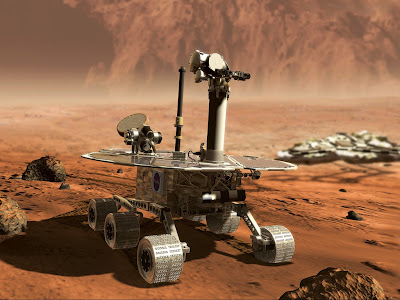
After a year of fruitlessly trying to communicate with Spirit, one of two rovers on the surface of Mars, NASA scientists have finally decided to let it rest in peace. They plan to send their last commands to the rover a little after midnight Wednesday.

Spirit, which landed on Mars in January 2004, has been stuck in Martian sand for two years and has been silent for more than a year, despite regular attempts by NASA scientists to contact it.

Along with its twin rover Opportunity, which landed on the opposite side of the planet, it was sent to explore the Martian landscape for about three months. Yet although they were not built to survive the planet's harsh winters, the two have far outlived their life expectancies and their mission has proven wildly successful, sending back strong evidence, for example, that water once shaped Mars' surface.

Read More

Monday, May 23, 2011

NASA Plans Test of New Moon Lander Morpheus

Moon Lander Morpheus
A squat, insectlike contraption is set to fly untethered for the first time soon in a NASA test of technologies designed to take humans to the moon, Mars or beyond.

The unmanned Morpheus lander, named after the Greek god of dreams, was built at NASA's Johnson Space Center in Houston using cutting-edge technologies that the agency hopes will one day enable manned missions to another planet or even an asteroid. The vehicle, about the size of an SUV, could carry about 1,100 pounds (500 kg) of cargo to the moon.

Not only are the technologies onboard innovative, but NASA's process of building the lander is, too.

"Part of what this project set out to do was to question the way we've done things," Project Morpheus manager Matt Ondler told SPACE.com. "We purposefully set out to see if we could do things faster and cheaper, leveraging off the work that was already done."

So far, the project has cost NASA about $4 million over the last 18 months, not counting the NASA work force, which is accounted for under NASA's general overhead.

Read more:

Wednesday, May 11, 2011

Dawn Planetary Delights

Planets Get Closer
During the month of May, four bright Planets will grace the morning sky just before dawn.

The planets Venus, Jupiter, Mercury and Mars will be involved in a series of conjunctions (close together) and will finally be joined by the thin crescent moon at the end of the month.

Twice during May some of the planets will converge to form a trio, where 3 planets will fit in an imaginary circle roughly 5 degrees across.

On the 11th Mercury, Venus and Jupiter will be within 2.5 degrees of each other, forming a very tight trio and on the 21st another trio will be formed by Mercury, Venus and Mars.

On the 29th, 30th, and 31st, the waning crescent moon will arrive, moving past Jupiter, Mars, Venus and Mercury stretched out in a line across the eastern sky.

Read More

Monday, May 09, 2011

NASA considers Mars and Titan probes

Mars and Titan probes
NASA said Friday it will choose its next mission from among studies of the inside of Mars, a sea on a moon of Saturn or a comet's nucleus.

Teams will get $3 million apiece to sketch out each mission, and one will be chosen for a 2016 launch, the space agency said.

The winning project is to cost no more than $425 million, not counting the cost of the launch vehicle.

One option, the Geophysical Monitoring Station, would study the structure and composition of the martian interior.

The Titan Mare Explorer would carry out the first direct exploration of an extraterrestrial ocean by landing in and floating on a methane-ethane sea on that moon of Saturn.

The Comet Hopper probe would study comet evolution by landing on a comet repeatedly and observing its changes during its course around the sun.

Meanwhile, the European Space Agency said Friday images from its Mars Express show a system of deep fractures in the crust around the Isidis impact basin. Some of the cracks are 1,600 feet deep

Read more:

Tuesday, May 03, 2011

Is our space vision still shortsighted?

Moon and Mars
Two years ago, retired aerospace executive Norman Augustine headed up a commission that led the White House to scrap NASA's "unexecutable" back-to-the-moon program and focus instead on a step-by-step path to send humans beyond Earth orbit, to an asteroid by 2025, and to the environs of Mars by the 2030s.

Now NASA is nearing the end of the shuttle program, gearing up to mark Thursday's 50th anniversary of U.S. human spaceflight ... and dealing with an uncertain future for human spaceflight. Augustine says NASA is mostly following the short-term prescription he and his colleagues have laid out, but he worries that NASA's long-term future could be a case of deja vu all over again.

In an interview, Augustine told me that NASA could once again face a situation where its budget doesn't match the task it's been given. The current year's $18.45 billion budget is a bit less than last year's, and includes $3 billion for work on a heavy-lift rocket and a spaceship that could eventually go beyond Earth orbit.

Read More

Sunday, May 01, 2011

Dry ice hints at 'Dust Bowl' on Mars

Dry Ice on MARS
Think Mars today is a hostile place? It was worse 600,000 years ago, according to new research that suggests the planet had a dustier, stormier atmosphere.

"It was an unpleasant place to hang out," said lead researcher Roger Phillips of the Southwest Research Institute in Texas. He said Mars' climate was probably something like the American Dust Bowl of the 1930s - but a lot worse.

The evidence comes from the discovery of a huge underground reservoir of dry ice, or frozen carbon dioxide, at its south pole - much more than scientists realized. They suspect some of that store of carbon dioxide was once in Mars' atmosphere, making it denser.

In the recent geologic past, when Mars' axis tilted, sunlight reached the southern polar cap and melted some of the frozen carbon dioxide. This release would have made the atmosphere thicker and caused more dust to loft into the air, creating severe storms. Other times, carbon dioxide cycled back into the ground as part of a seasonal cycle.

Read more:

Thursday, April 28, 2011

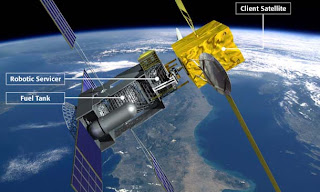
Fill 'er up at an interstellar gas station

Gas Station
A spaceship isn't much use if it doesn't have the juice to go somewhere. And if you're an astronaut bouncing around destinations like the moon, random asteroids, Lagrange points, and Mars, you'll probably need an interstellar gas station.

NASA has launched an "In-Space Cryogenic Propellant Storage and Transfer Demonstration Mission Concept (PDF)" study, which is essentially a call for scientific institutions around the globe to help create a space gas station. Those wishing to build a fueling stop in the sky have until May 23 to submit their proposals.

Cryogenic propellants used in rocket engines are usually made of liquid hydrogen and liquid oxygen. Both liquids reside in enormous insulated containers and are pumped through an expansion chamber, then mixed and ignited in the combustion chamber. The result is an incredible amount of power per gallon of cryogenic proellant, up to 40 percent higher than other rocket fuels.

However, there are many challenges to creating a gas station in the stars. The primary objectives of the study are to address key elements including a fail-safe way to transfer the propellants from a storage container to a ship. The difficulty is high since hydrogen tends to leak (it's the smallest element), and can eventually deteriorate the container it's stored in.

Read more:

Sunday, April 10, 2011

Volcanoes Reveal the Cooling of Mars

The mantle of Mars is possibly cooling by 30-40°C every billion years. Based on satellite observations of the composition of the planet's volcanic rocks, researchers from CNRS and the Université Paul Sabatier in Toulouse reached this conclusion after reconstructing for the first time the thermal evolution of the planet over the past 4 billion years. These values indicate that cooling is slower than on Earth and highlight the specific nature of our planet, where thermal evolution is affected by plate tectonics. These findings were recently published in the journal Nature.

The history of water and of climate evolution on Mars has received considerable attention over the past few decades. However, the evolution of a planet needs to be considered in its entirety. This requires an understanding of the thermal and dynamic evolution of the planetary interior in relation to volcanic or tectonic activity.

Monday, April 04, 2011

Hot then cold, ready for your close up, Mr Mercury

Mercury
He's really hot, really cold, maybe even a bit icy. He is the planet Mercury and this month he is ready for his extended close-up.

On Wednesday, NASA showed the first pictures taken by its Mercury Messenger spacecraft, which entered the planet's orbit on March 17.

Messenger will spend at least a year photographing, measuring and studying Mercury, which for now is the last frontier of planetary exploration.
Advertisement: Story continues below

''This is the last of the classical planets, the planets known to the astronomers of Egypt and Greece and Rome and the Far East,'' the principal investigator, Sean Solomon of the Carnegie Institution of Washington, said.

It ''captivated the imagination and the attention of astronomers for millennia'', Dr Solomon said, but science had never had such a front-row seat. ''We're there now.''

The space agency has sent orbiters to five planets - Mercury, Venus, Mars, Jupiter and Saturn - but it probably will take a decade or two before a spacecraft orbits Uranus or Neptune. (In 2015, NASA's New Horizons spacecraft will zoom past Pluto - which is no longer regarded as a planet.)

Half a dozen fly-bys by NASA probes - three by Mariner 10 in the 1970s and three by Messenger in the past three years - have seen Mercury close up, though briefly.

Read More

Friday, April 01, 2011

NASA Airborne Radar Set to Image Hawaiian Volcano


The Kilauea volcano that recently erupted on the Big Island of Hawaii will be the target for a NASA study to help scientists better understand processes occurring under Earth's surface. A NASA Gulfstream-III aircraft equipped with a synthetic aperture radar developed by NASA's Jet Propulsion Laboratory in Pasadena, Calif., is scheduled to depart Sunday, April 3, from the Dryden Aircraft Operations Facility in Palmdale, Calif., to the Big Island for a nine-day mission.

The Uninhabited Aerial Vehicle Synthetic Aperture Radar, or UAVSAR, uses a technique called interferometric synthetic aperture radar that sends pulses of microwave energy from the aircraft to the ground to detect and measure very subtle deformations in Earth's surface, such as those caused by earthquakes, volcanoes, landslides and glacier movements. As the Gulfstream-III flies at an altitude of about 12,500 meters (41,000 feet), the radar, located in a pod under the aircraft's belly, will collect data over Kilauea. The UAVSAR's first data acquisitions over this volcanic region took place in January 2010, when the radar flew over the volcano daily for a week. The UAVSAR detected deflation of Kilauea's caldera over one day, part of a series of deflation-inflation events observed at Kilauea as magma is pumped into the volcano's east rift zone.

Thursday, March 31, 2011

MESSENGER Images from Orbit of Mercury-NASA Information


MESSENGER has delivered its first image since entering orbit about Mercury on March 17. It was taken today at 5:20 am EDT by the Mercury Dual Imaging System as the spacecraft sailed high above Mercury’s south pole, and provides a glimpse of portions of Mercury's surface not previously seen by spacecraft. The image was acquired as part of the orbital commissioning phase of the MESSENGER mission. Continuous global mapping of Mercury will begin on April 4.

“The entire MESSENGER team is thrilled that spacecraft and instrument checkout has been proceeding according to plan,” says MESSENGER Principal Investigator Sean Solomon, of the Carnegie Institution of Washington. “The first images from orbit and the first measurements from MESSENGER’s other payload instruments are only the opening trickle of the flood of new information that we can expect over the coming year. The orbital exploration of the Solar System’s innermost planet has begun.”

Tuesday, March 29, 2011

NASA scraps plan for 3D camera on Mars Rover

MARS
NASA has given up on the hope to build a 3D camera for the next robotic rover that the space agency will send to Mars.

Time simply ran out on efforts to develop the system and get it sufficiently tested before the Mars Science Laboratory rover, which has been dubbed Curiosity, is scheduled to launch later this year.

Movie director James Cameron, of Avatar and Titanic fame, has been helping to build the new camera, which would have both zoom and 3D capabilities.

Cameron has been working with Malin Space Science Systems of San Diego to build what would have been a 3D upgrade to the camera, dubbed Mastcam, already installed on Curiosity.

"With the Mastcam that was installed last year and the rover's other instruments, Curiosity can accomplish its ambitious research goals," Mars Science Laboratory Project Scientist John Grotzinger said in a written statement.

"The possibility for an upgrade was very much worth pursuing, but time became too short for the levels of testing that would be needed for them to confidently replace the existing cameras," Grotzinger.

Read More

Wednesday, March 23, 2011

NASA's Orion begins road to space travel

moon
Lockheed Martin unveiled a new spacecraft this week that was originally meant to ferry astronauts to the moon but may first be used as an emergency escape vehicle for the International Space Station.

At the same time that the company was taking the wraps off of Orion, it also was showing off a new massive test facility near Denver. The 41,000-square-foot facility is designed to simulate deep-space environments, as well as missions to an asteroid or the moon.

Slated to conduct its first orbital flight test as early as 2013, the Orion spacecraft is set to undergo testing in the new facility to make sure it's able to endure the harsh environments of deep space.

Orion is on track to begin running real space missions by 2016.

John Karas, vice president and general manager for Lockheed Martin's Human Space Flight programs, said in a statement, "Our nation's next bold step in exploration could begin by 2016."

"Orion was designed from inception to fly multiple, deep-space missions," Karas said. "The spacecraft is an incredibly robust, technically advanced vehicle capable of safely transporting humans to asteroids, Lagrange Points and other deep space destinations that will put us on an affordable and sustainable path to Mars."

Orion was first conceived as part of NASA's Constellation program, which was geared to return humans to the moon by 2020. However, last year the Obama administration scrapped the over-budget and behind-schedule Constellation program, deciding instead to focus on sending astronauts to Mars and further into the solar system.

Read More

Monday, March 14, 2011

'Weirdest planet' Mercury to get NASA close-up

mars
Earth is about to get better acquainted with its oddball planetary cousin, Mercury, a rocky wonderland of extremes.

Sure, Mars may fascinate science fiction authors, Jupiter looms large and Saturn has stunning rings, but tiny Mercury can claim the title as weirdest planet in the solar system. It has the wildest extremes from hot to cold. A day on Mercury somehow lasts longer than its year. And maybe strangest of all, scientists think it holds tons of ice in dark craters despite being the planet closest to the sun.

On St. Patrick's Day, for the first time, a small NASA spacecraft called Messenger will enter into Mercury's orbit, circling at times as close as 125 miles from the planet's surface. And by coincidence, a few days before that will be the best time all year for people on Earth to see Mercury with the naked eye.

Barely bigger than our moon but much more distant, Mercury is not easy to see without a telescope. An odd pairing with giant Jupiter will make it easier to spot starting Sunday - probably the best opportunity for a year, said Geoff Chester at the U.S. Naval Observatory in Washington.

Chester said people in the Northern Hemisphere should look to the west after sunset. Jupiter will be about 10 degrees above the western horizon. Mercury will be about finger's width to the right of Jupiter.

Read More

Friday, March 11, 2011

Anaglyph of Vesta Model

moon
This anaglyph -- best viewed through red-blue glasses -- shows a 3-D model of the protoplanet Vesta, using scientists' best guess to date of what the surface of the protoplanet might look like. It was created as part of an exercise for NASA's Dawn mission involving mission planners at NASA's Jet Propulsion Laboratory and science team members at the Planetary Science Institute in Tuscon, Ariz.

The images incorporate the best data on dimples and bulges of the protoplanet Vesta from ground-based telescopes and NASA's Hubble Space Telescope. The cratering and small-scale surface variations are computer-generated, based on the patterns seen on the Earth's moon, an inner solar system object with a surface appearance that may be similar to Vesta.

Vesta, located in the main asteroid belt between Mars and Jupiter, formed very early in the history of the solar system and has one of the oldest surfaces in the system. Scientists are eager to get their first close-up look so they can better understand this early chapter.

Dawn science planners have used images like these to ensure optimal images when Dawn gets into orbit around Vesta in July 2011.

The Dawn mission to Vesta and Ceres is managed by the Jet Propulsion Laboratory, a division of the California Institute of Technology in Pasadena, for NASA's Science Mission Directorate in Washington, DC. It is a project of the Discovery Program managed at NASA's Marshall Space Flight Center

Read More

Friday, March 04, 2011

China to put man on the moon by 2030

moon
China plans to make a manned moon landing by 2030, but the purpose of exploration of the moon should be seen as "peaceful" rather than a threat, a top scientist has said.

Ye Peijian, chief scientist of deep space exploration at the China Academy of Space Technology, said China's space technology still lags far behind the US and Russia, according to China Daily.

China's three-phase moon exploration plan began in October 2010 with the launch of the Chang'e-2. The second phase will see the Chang'e-3 land on the moon in 2013. Then, in 2017, a sample of rock from the moon will be sent to Earth.

China will launch a space module - the 8.5-tonne Tiangong-1 (or Heavenly Palace-1) - in 2011, after which two manned spacecraft would dock with the module in 2012, said a spokesman for the China Manned Space Engineering Office.
The Shenzhou IX and Shenzhou X spacecraft will blast off in 2012 for manned docking with Tiangong-1.

Training of astronauts for the manned missions has begun. China has also recruited its first two women astronauts for training.

Read More

Wednesday, February 23, 2011

Meteorites yield Mars water clues


Rare fragments of martian meteorites have revealed evidence of how water once flowed near the surface of that planet, U.K. researchers say.
Scientists at the University of Leicester have examined five samples of nakhlite -- a form of meteorite known to have originated on Mars and named after the Egyptian village of el-Nakhla where the first one was found in 1911 -- using an electron microscope, a university release said Wednesday.
The samples showed veins created during an impact on Mars and filled with clay, carbonite and other materials probably carried there by water from ice melted in the impact, John Bridges of Leicester's Space Research Center says.
The discovery closely ties in to recent geological discoveries of clay and carbonate on the surface of Mars made by NASA and European Space Agency probes, and suggests how some of it probably formed.
"We are now starting to build a realistic model for how water deposited minerals formed on Mars, showing that impact heating was an important process," Bridges said.
"With models like this we will better understand the areas where we think that water was once present on Mars."

Read More