Showing posts with label Earth. Show all posts

Sunday, November 13, 2011

Russians desperately try to save Mars moon probe

mars_moon_probe
A Russian space probe became stuck in orbit this week after an equipment failure, raising fears it could come crashing down and spill tons of highly toxic fuel on Earth unless engineers can steer it back to its flight path the spacecraft was headed for one of Mars' two moons when it developed technical problems.

U.S. space and Defense Department officials are tracking it. Officials at NASA in Washington figure it will be at least a week, maybe more, before the errant space probe falls to Earth, if it does. The Russians are trying to get it back on course one independent U.S. expert on the Russian space program said the spacecraft could become the most dangerous manmade object ever to hit the planet. But those at the U.S. space agency and other space debris experts are far less worried. They believe the fuel will probably explode harmlessly in Earth's upper atmosphere.

NASA chief debris scientist Nicholas Johnson said the spacecraft's orbit is already starting to degrade slightly "From the orbits we're seeing from the U.S. Space Surveillance Network, it's going to be a couple weeks before it comes in," Johnson said Wednesday afternoon. "It's not going to be that immediate."

Tourism Links

Friday, April 01, 2011

NASA Airborne Radar Set to Image Hawaiian Volcano


The Kilauea volcano that recently erupted on the Big Island of Hawaii will be the target for a NASA study to help scientists better understand processes occurring under Earth's surface. A NASA Gulfstream-III aircraft equipped with a synthetic aperture radar developed by NASA's Jet Propulsion Laboratory in Pasadena, Calif., is scheduled to depart Sunday, April 3, from the Dryden Aircraft Operations Facility in Palmdale, Calif., to the Big Island for a nine-day mission.

The Uninhabited Aerial Vehicle Synthetic Aperture Radar, or UAVSAR, uses a technique called interferometric synthetic aperture radar that sends pulses of microwave energy from the aircraft to the ground to detect and measure very subtle deformations in Earth's surface, such as those caused by earthquakes, volcanoes, landslides and glacier movements. As the Gulfstream-III flies at an altitude of about 12,500 meters (41,000 feet), the radar, located in a pod under the aircraft's belly, will collect data over Kilauea. The UAVSAR's first data acquisitions over this volcanic region took place in January 2010, when the radar flew over the volcano daily for a week. The UAVSAR detected deflation of Kilauea's caldera over one day, part of a series of deflation-inflation events observed at Kilauea as magma is pumped into the volcano's east rift zone.

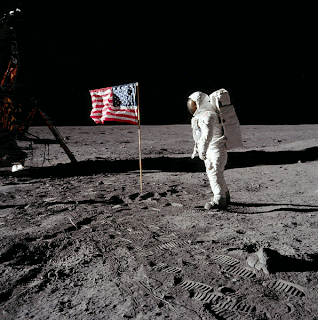
The astronauts of planet Earth

Moon
In the 50 years since Yuri Gagarin first soared into space, 520 men and women have taken their own space odysseys. They have come from 38 countries, carried on American, Russian and, recently, Chinese vehicles. All have been proud to represent their nations. Now, in a special issue honouring their achievements, FT Weekend Magazine has interviewed an astronaut from 35 of these countries. The project involved 17 writers, 11 languages and a rather flustered mission control – but it resulted in stories as diverse and entertaining as the voyagers themselves. May we present … the astronauts of Planet Earth.

The human history of space began on the morning of April 12 1961. After a breakfast of meat paste and marmalade, squeezed from a tube, a 27-year-old lieutenant in the Soviet air force, Yuri Alekseyevich Gagarin, was helped into a bulky orange flying suit. With his back-up, Gherman Titov, he was driven in a bus to a launch pad on the desolate Tyuratam missile-testing site on the steppes of Kazakhstan. According to Soviet lore, Gagarin then gave a short speech to the crowd of engineers, scientists and mechanics gathered in the early morning sunshine. “Dear friends,” he began. “What can I tell you in these last minutes before the launch? My whole life appears to me as one beautiful moment. All that I previously lived through and did, was lived through and done for the sake of this moment.”

Those words, written for Gagarin, had actually been recorded in Moscow. On the morning of his flight, he simply said goodbye, clanked helmets awkwardly with Titov, and was then taken up and strapped into a small spherical pod attached to a 300-tonne rocket that had been designed to carry nuclear weapons. For the next two hours, as the scientists fussed and took tranquilliser pills, Gagarin became slightly bored and asked for some music to be piped in. He said the first, true human words of a cosmonaut as his Vostok “satellite-ship” began to rise from the earth at 9.06.59am, his heart beating almost three times a second: “Let’s go!”

Read More

Monday, October 26, 2009

Undergrad Proposal Deadline Nears for NASA Reduced Gravity Flights

NASAThe deadline is fast-approaching for undergraduate students to submit their team proposals to NASA's Reduced Gravity Education Flight Program. Proposals must be received by 11:59 p.m. CDT , Wednesday, Oct. 28.

NASA's Reduced Gravity Education Flight Program gives aspiring explorers a chance to propose, design and fabricate a reduced gravity experiment. Selected teams will get to test and evaluate their experiment aboard a modified Boeing 727 jetliner provided by the Zero-Gravity Corporation of Las Vegas . Zero-Gravity Corporation will conduct the flights in cooperation with the Reduced Gravity Office at NASA's Johnson Space Center in Houston .

The aircraft will fly approximately 30 roller-coaster-like climbs and dips during experiment flights to produce periods of weightlessness and hyper-gravity ranging from 0 g to 2 g.
"Today's students will be conducting tomorrow's space exploration," said Douglas Goforth, the program manager at Johnson. "Conducting a hands-on research and engineering project in a truly reduced gravity laboratory gives students a head start in preparing for those future ventures."

All applicants must be full-time students, U.S. citizens and at least 18 years old. NASA will announce selected teams Dec. 9. Teams will fly in the summer of 2010. Selected teams also may invite a full-time, accredited journalist to fly with them and document the team's experiment and experiences.

Through this program, NASA continues its tradition of investing in the nation's education programs. It is directly tied to the agency's education goal of strengthening NASA and the nation's future workforce. Through this and other college and university programs, NASA will identify and develop the critical science, technology, engineering and mathematics skills and capabilities needed to carry out its space exploration mission.

Thursday, October 22, 2009

Building an Original

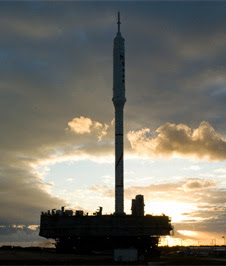
327-foot-tall Ares I-X rocketAres I-X has completed the first leg of its upcoming mission.

NASA's newest rocket -- currently the largest in the world -- emerged from the Vehicle Assembly Building at 1:39 a.m. EDT Oct. 20, 2009, beginning a 7.5-hour trek through the predawn darkness to Launch Pad 39B at Kennedy Space Center in Florida.

It's the first new vehicle to occupy Launch Pad 39B in more than 25 years.

The goal of the test is to give NASA the chance to see the Ares I flight hardware, facilities and launch procedures in action. With more than 700 sensors on board, Ares I-X is wired to relay ascent data that will be critical for future flights.

The 1.8-million-pound rocket stayed "steady as a rock" throughout the 4.2-mile journey, according to NASA's Jon Cowart, one of two Ares I-X deputy mission managers overseeing the assembly and launch.
Steep ladders mounted inside the upper stage simulator
"For those of us who've lived with the shuttle and grew up looking at the Saturn Vs, it's obviously a little different than what we're used to seeing," Cowart said as the tracked crawler-transporter carried the 327-foot-tall rocket and its mobile launcher platform to the top of the pad. The rocket's upper stage loomed high above the top of the pad's fixed service structure, surpassed only by the pad's three lightning masts.

Closer in height to the hulking Saturn V moon rockets than the space shuttle, Ares I-X looks unlike any rocket that's ever stood at Launch Complex 39. But it blends familiar hardware from existing programs with newly developed components.

Four first-stage, solid-fuel booster segments are derived from the Space Shuttle Program. A simulated fifth booster segment contains Atlas-V-based avionics, and the rocket's roll control system comes from the Peacekeeper missile. The launch abort system, simulated crew and service modules, upper stage, and various connecting structures all are original.

'We've Got a Rocket'

Ares I-X in High Bay 3
The fast-paced assembly sequence kicked off in late 2008, when flight hardware began arriving at the Florida spaceport from NASA field centers and contractors across the country.

In order to handle the influx of Ares I-X components, the processing team needed more room than the Vehicle Assembly Building's High Bay 3 and booster facilities could provide. So elements were stored, inspected, fitted or joined together in additional facilities across the space center, and even at the Astrotech Space Operations facility in nearby Titusville, Fla.

The simulated upper stage arrived in November 2008 aboard the Delta Mariner barge after a journey from NASA's Glenn Research Center in Ohio. In January 2009, a C5 cargo plane carried the full-scale crew module simulator and launch abort system from the agency's Langley Research Center in Virginia to Kennedy's Shuttle Landing Facility.

As assembly began, NASA Vehicle Processing Engineer Trent Smith was tasked with ensuring the work was done in the right order and that all necessary parts and personnel were available.

"When the hardware started showing up, I thought, 'Oh wow, it's here,' " Smith said. "We've got a rocket!"

Along with the crew module and abort tower, the upper stage's seven tuna can-shaped pieces, service module, spacecraft adapter and two interstage connectors were staged in the Vehicle Assembly Building's High Bay 4 prior to stacking.

The funnel-like frustum, forward skirt with its extension, and simulated fifth booster segment arrived from Indiana, where they were manufactured by Major Tool and Machine. First-stage prime contractor ATK Space Systems built the four solid-fueled booster segments, which reached Kennedy in March 2009 after a seven-day, cross-country train ride from Utah.

Stacking Begins

Smaller sections called "super stacks" were assembled first. The two interstage pieces, frustum, forward skirt and extension were mated to the simulated fifth booster segment in early July, completing Super Stack 1.

A day later, the aft, or bottom, segment of the first-stage solid booster rolled into the Vehicle Assemble Building and was secured to the mobile launcher platform in High Bay 3, marking the official start of final assembly.

"When we started stacking, it was a very big deal for us," Cowart said of the Ares I-X team. "We stacked all four of the boosters, then we were ready to bring over Super Stack 1."

Ares I-X finally was taking shape.

The first "tuna can" segment, comprising upper stage segment 1, was labeled Super Stack 2. Upper stage segments 2 through 5 made up Super Stack 3, and Super Stack 4 comprised upper stage segments 6 and 7. Segments 1 and 7 contain steel ballasts weighing a combined 160,000 pounds to mimic the weight of the Ares I liquid propellant tanks.

"I remember going up to Level 34 and looking down, and going on the E roof -- which is right about where the fifth segment simulator is -- and looking up, then down," Smith said. "That's when it really dawned on us that this is a tremendously tall rocket."

Barely five weeks after stacking began, Ares I-X was crowned with Super Stack 5, consisting of the launch abort system, crew module, service module and spacecraft adapter. The completed rocket towered above the surface of the mobile launcher platform, leaving only 10 feet of clearance for the heavy-lift crane to remove the birdcage-shaped framework that lowered the final pieces into place.

Assembly of the one-of-a-kind launch vehicle finally was complete. But plenty of work remained. The rocket was put through its paces: a power-up test, or "smoke test," to validate the electronics boxes and wiring; a "sway test" to check the vehicle's response to vibrations it could face during rollout; instrumentation tests; and a simulated countdown and liftoff.

Positioned for Launch

Once Ares I-X arrived at Launch Pad 39B, remaining milestones included a hot-fire of the rocket's auxiliary power units and checkout of the communications, instrumentation and telemetry. On launch day, most team members will be at their consoles seven hours before the opening of a four-hour launch window; Smith will ensure things are going well at the launch pad before retreating to a facility a safe distance away.

A successful liftoff will cap a demanding development and assembly process that Cowart believes illustrated NASA's entrepreneurial capability, as well as the dedication of the relatively small team that brought this flight from paper to reality.

Smith emphasized that the Ares I-X effort involved design centers, research centers, and multiple contractors -- all of which intersected at Kennedy.

"There was some education on all sides. Integrating and communicating were key to our success," he said. "What made it so rewarding was working through all the challenges and frustrations."

The Ares I-X flight test vehicle was still a concept about four years ago, Cowart pointed out.

"This is unprecedented in NASA history, for a rocket of this size," he said. "It's incredible."