Monday, May 30, 2011

Moon men: U.S. space leadership slipping

Moon Men
While America pauses to remember President Kennedy’s moon challenge 50 years ago, three famous astronauts think we have “strayed widely from President Kennedy’s vision and the will of the American people.”

Neil Armstong and Eugene Cernan, the first and last men to walk on the moon, joined Jim Lovell, whose ill-fated Apollo 13 mission cut short his journey to the lunar surface, have written a column in USA Today, suggesting that President Obama advisors, “in searching for a new and different NASA strategy with which the president could be favorably identified, have ignored NASA’s operational mandate.”

After tracing America’s awesome achievements of the past five decades, the retired astronauts note how the Constellation program NASA was developing to venture back to the moon and on to Mars enjoyed near unanimous support in Congress and the Bush administration but fell behind schedule and was deemed “not viable” by a review panel, due to inadequate funding.
SHOCK WAVES

When the president failed to include funds for Constellation in his 2010 budget, “it sent shock waves throughout NASA, the Congress and the American people. Nearly $10 billion had been invested in design and development of the program,” they said.

Read More

Friday, May 27, 2011

Four planets align near moon on holiday weekend

Moon
The unusual month-long convergence of four planets in the pre-dawn sky is nearing an end, as the planets begin separating from each other and going their separate ways. But one final series of meetings is on tap for this Memorial Day weekend.

Between Sunday and Tuesday, the planets Jupiter, Venus, Mars and Mercury will appear in a grouping with a bonus visitor: the moon. Weather permitting, skywatchers can look low to the east-northeast horizon about a half hour before sunrise and see the four planets arrayed in a line.

The sky map of the four planets here shows how they will appear from mid-northern latitudes in North America on Monday (May 30).

Your clenched fist held at arm’s length measures roughly 10 degrees of the sky, and the planetary alignment will stretch across 20 degrees.

Read More

Thursday, May 26, 2011

Moon rocks yield watery secrets

Moon
Scientists shocked lunar moisture skeptics in 2009 when NASA announced that it had found water. Now, new research out of Brown University in Providence, R.I., suggests that the moon could be soaked.

After testing tiny bits of molten rock from volcanic glass deposits sampled during NASA’s Apollo missions, the Brown researchers found traces of water in lunar magma that dwarfed prior samples. Their report, published in Thursday’s issue of Science Express, corroborates a theory team member and Brown geologist Alberto Saal published in the journal Nature in 2008. Saal hypothesized that the moon’s magma would contain quantities of water comparable to those found in magma on Earth.

“We had predicted 20-100 times more [water than was previously seen],” team member and geochemist James Van Orman said. “That was a controversial thing.”

Van Orman’s group tested the samples, referred to as “lunar melt inclusions,” with a NanoSIMS 50L ion microprobe, a sensor using an accelerated particle beam to measure water.

Read More

50 Years After Kennedy's Speech, Mars Mission Still Distant

Mars Mission
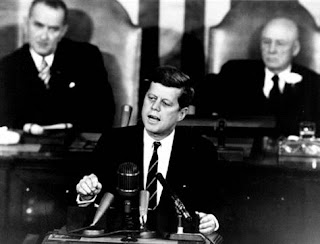
Today, May 25th, marks the 50th anniversary of President John F. Kennedy's famous speech challenging the U.S. to shoot for the moon, saying,"I believe that this nation should commit itself to achieving the goal, before this decade is out, of landing a man on the moon and returning him safely to Earth."

On May 25th, 1961, Kennedy's delivered the address on "Urgent National Needs" to Congress a mere six weeks after the Soviet Union sent Yuri Gagarin on the first human spaceflight on April 12 and twenty days after Alan Shepard's first American flight on May 5th.

The result of Kennedy's challenge was the Apollo program, which sent America and mankind on a journey that's still soaring to new heights.

Kennedy's goal was fulfilled on July 20, 1969, when Apollo 11's lunar module Eagle touched down in the Sea of Tranquility, with Neil Armstrong and Buzz Aldrin aboard. Before the Apollo program ended in 1972, six missions landed on the moon and a dozen men set foot on its pale, mysterious crust.

Fifty years after Kennedy urged America to take one giant leap for mankind, we've accomplished unimaginable achievements, launching space shuttles, landing robotic rovers, traveling all the way to Jupiter, and building space stations.

After all of our exploration, we are still fascinated by the moon though. NASA continues to study it with satellites images, and in October of last year, NASA discovered large amounts of water and ice on the moon.

Read More

Tuesday, May 24, 2011

Spirit's Mars mission comes to a close

Mars
It's been a year since the rover sent a signal. After Tuesday, NASA scientists will stop trying to send it commands. Its twin, Opportunity, continues to work 7 years into what was to be a 3-month mission.

After a year of fruitlessly trying to communicate with Spirit, one of two rovers on the surface of Mars, NASA scientists have finally decided to let it rest in peace. They plan to send their last commands to the rover a little after midnight Wednesday.

Spirit, which landed on Mars in January 2004, has been stuck in Martian sand for two years and has been silent for more than a year, despite regular attempts by NASA scientists to contact it.

Along with its twin rover Opportunity, which landed on the opposite side of the planet, it was sent to explore the Martian landscape for about three months. Yet although they were not built to survive the planet's harsh winters, the two have far outlived their life expectancies and their mission has proven wildly successful, sending back strong evidence, for example, that water once shaped Mars' surface.

Read More

Monday, May 23, 2011

Race to Space, Through the Lens of Time


It was the spring of 1961. President John F. Kennedy, speaking of new frontiers and projecting the vigor of youth, had been in office barely four months, and April had been the cruelest.

On the 12th, Yuri Gagarin became the first human to orbit Earth — one more space triumph for the Soviet Union. Though the flight was not unexpected, it was nonetheless deflating; it would be more than a month before Alan Shepard became the first American in space, and that was on a 15-minute suborbital flight. On the 17th, a force of anti-Castro exiles, trained by the C.I.A., invaded communist Cuba at the Bay of Pigs — a fiasco within 36 hours. Mr. Kennedy’s close aide Theodore Sorensen described him on the 19th as “anguished and fatigued” and “in the most emotional, self-critical state I had ever seen him.”

At one meeting, his brother Robert F. Kennedy, the attorney general, “turned on everybody,” it was reported, saying: “All you bright fellows. You got the president into this.

Read More

NASA Plans Test of New Moon Lander Morpheus

Moon Lander Morpheus
A squat, insectlike contraption is set to fly untethered for the first time soon in a NASA test of technologies designed to take humans to the moon, Mars or beyond.

The unmanned Morpheus lander, named after the Greek god of dreams, was built at NASA's Johnson Space Center in Houston using cutting-edge technologies that the agency hopes will one day enable manned missions to another planet or even an asteroid. The vehicle, about the size of an SUV, could carry about 1,100 pounds (500 kg) of cargo to the moon.

Not only are the technologies onboard innovative, but NASA's process of building the lander is, too.

"Part of what this project set out to do was to question the way we've done things," Project Morpheus manager Matt Ondler told SPACE.com. "We purposefully set out to see if we could do things faster and cheaper, leveraging off the work that was already done."

So far, the project has cost NASA about $4 million over the last 18 months, not counting the NASA work force, which is accounted for under NASA's general overhead.

Read more:

Thursday, May 12, 2011

Sky spy: Watch the ongoing predawn show

moon
The moon rises at 2:14 p.m. this afternoon and sets at 2:29 Friday morning. It is a gibbous (more than half lit) moon that is waxing (growing larger) toward full moon next Tuesday.

It is a good time to look at the moon with binoculars or a small telescope. The large dark areas on the moon are called maria (mare singular) which means sea in Latin.

The early telescopic observers of the moon in the 1600s thought the dark areas were large bodies of water. We now know they are cooled lava beds leftover from vast volcanic eruptions on the moon 3 to 4 billion years ago.

In contrast to the maria are white or gray regions, which are highlands containing mountains, plains, and valleys. Craters are scattered all over the moon, and the southern portion of the moon, the southern highlands, is heavily covered with crater- speckled mountains and hills.

Don't forget about the ongoing planetary show in the predawn morning sky. Sometimes the best sky shows happen at the most inconvenient times.

Sunrise is at 5:27 Friday morning. A good way to start off Friday the 13th is to rise early and look at the eastern sky starting at 4:50 a.m. Get a low, unobstructed horizon. Brilliant Venus will catch your eye. Just above Venus will be Jupiter and just below Venus will be Mercury. A little off to the left (north) will be Mars.

Read More

Wednesday, May 11, 2011

Dawn Planetary Delights

Planets Get Closer
During the month of May, four bright Planets will grace the morning sky just before dawn.

The planets Venus, Jupiter, Mercury and Mars will be involved in a series of conjunctions (close together) and will finally be joined by the thin crescent moon at the end of the month.

Twice during May some of the planets will converge to form a trio, where 3 planets will fit in an imaginary circle roughly 5 degrees across.

On the 11th Mercury, Venus and Jupiter will be within 2.5 degrees of each other, forming a very tight trio and on the 21st another trio will be formed by Mercury, Venus and Mars.

On the 29th, 30th, and 31st, the waning crescent moon will arrive, moving past Jupiter, Mars, Venus and Mercury stretched out in a line across the eastern sky.

Read More

Monday, May 09, 2011

NASA considers Mars and Titan probes

Mars and Titan probes
NASA said Friday it will choose its next mission from among studies of the inside of Mars, a sea on a moon of Saturn or a comet's nucleus.

Teams will get $3 million apiece to sketch out each mission, and one will be chosen for a 2016 launch, the space agency said.

The winning project is to cost no more than $425 million, not counting the cost of the launch vehicle.

One option, the Geophysical Monitoring Station, would study the structure and composition of the martian interior.

The Titan Mare Explorer would carry out the first direct exploration of an extraterrestrial ocean by landing in and floating on a methane-ethane sea on that moon of Saturn.

The Comet Hopper probe would study comet evolution by landing on a comet repeatedly and observing its changes during its course around the sun.

Meanwhile, the European Space Agency said Friday images from its Mars Express show a system of deep fractures in the crust around the Isidis impact basin. Some of the cracks are 1,600 feet deep

Read more:

Thursday, May 05, 2011

WVU Students Builds Robot for the Moon

Moon Robot
A group of WVU students is building a robot that can work on the moon.

A lunabotics team of 15 engineering students is competing in NASA's second annual Lunabotics Mining Competition. They're designing a remote controlled excavation robot capable of collecting and depositing simulated moon soil.

The students say technology like this will make sustainable human settlement on the moon and Mars a possibility.

"The idea being that we are going to put robot's in place of astronauts, and so we wanna create the first wave of that lunar colonization for their exploration. It's just a really neat thing," said lunabotics team member Ben Knabenshue.

The WVU/NASA space grant consortium is sponsoring the project.

Former astronaut and WVU alum Jon McBride is advising the team.

Read More

Tuesday, May 03, 2011

Is our space vision still shortsighted?

Moon and Mars
Two years ago, retired aerospace executive Norman Augustine headed up a commission that led the White House to scrap NASA's "unexecutable" back-to-the-moon program and focus instead on a step-by-step path to send humans beyond Earth orbit, to an asteroid by 2025, and to the environs of Mars by the 2030s.

Now NASA is nearing the end of the shuttle program, gearing up to mark Thursday's 50th anniversary of U.S. human spaceflight ... and dealing with an uncertain future for human spaceflight. Augustine says NASA is mostly following the short-term prescription he and his colleagues have laid out, but he worries that NASA's long-term future could be a case of deja vu all over again.

In an interview, Augustine told me that NASA could once again face a situation where its budget doesn't match the task it's been given. The current year's $18.45 billion budget is a bit less than last year's, and includes $3 billion for work on a heavy-lift rocket and a spaceship that could eventually go beyond Earth orbit.

Read More

Monday, May 02, 2011

Students illustrate their ideas of space travel

Space Travel
Space exploration may include a base on the moon or large airplane-like transporters, according to the artistic creations of Orangeville Christian School students.

A group of seven students — the gifted class — recently learned all three of their entries in a competition held by the International Academy of Astronautics finished high in the rankings. As such, their works were put on display for space travelers, scientists and others during the Humans in Space Symposium in Houston, Texas April 11 to 15.
“I’m super excited for them,” teacher Vicki Marcus said. “I’m very proud of them.”

Under the guidance of Marcus and Laurie Smith, owner of Z’Arts Studio in Hockley Valley, the students researched and drafted their ideas on computers last fall. They then printed them on canvas and finished them with acrylic paints.

Sunday, May 01, 2011

Dry ice hints at 'Dust Bowl' on Mars

Dry Ice on MARS
Think Mars today is a hostile place? It was worse 600,000 years ago, according to new research that suggests the planet had a dustier, stormier atmosphere.

"It was an unpleasant place to hang out," said lead researcher Roger Phillips of the Southwest Research Institute in Texas. He said Mars' climate was probably something like the American Dust Bowl of the 1930s - but a lot worse.

The evidence comes from the discovery of a huge underground reservoir of dry ice, or frozen carbon dioxide, at its south pole - much more than scientists realized. They suspect some of that store of carbon dioxide was once in Mars' atmosphere, making it denser.

In the recent geologic past, when Mars' axis tilted, sunlight reached the southern polar cap and melted some of the frozen carbon dioxide. This release would have made the atmosphere thicker and caused more dust to loft into the air, creating severe storms. Other times, carbon dioxide cycled back into the ground as part of a seasonal cycle.

Read more:

Friday, April 29, 2011

China to send men to moon and Mars

China Moon and Mars
Announced earlier in the week, the station will weigh 60 tons; about one seventh of the mass of today's International Space Station. Unmanned, its first module should be launched later this year, and then hooked up to two following manned modules. Participating in the briefing, astronaut Yang Liwei admitted the Center's engineers were finding the development of sophisticated docking technology, needed to create the country's first multi-module spaceship, to be a challenge.

"In 2003 China became the third nation to put a man into space. The first Chinese space walk followed five years later in 2008."

Looking ahead, China wants to put a man on the moon by 2025 and then send a man to Mars before the year 2060. Of course the dream does not end there.

Read More

Thursday, April 28, 2011

Fill 'er up at an interstellar gas station

Gas Station
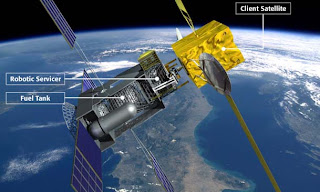
A spaceship isn't much use if it doesn't have the juice to go somewhere. And if you're an astronaut bouncing around destinations like the moon, random asteroids, Lagrange points, and Mars, you'll probably need an interstellar gas station.

NASA has launched an "In-Space Cryogenic Propellant Storage and Transfer Demonstration Mission Concept (PDF)" study, which is essentially a call for scientific institutions around the globe to help create a space gas station. Those wishing to build a fueling stop in the sky have until May 23 to submit their proposals.

Cryogenic propellants used in rocket engines are usually made of liquid hydrogen and liquid oxygen. Both liquids reside in enormous insulated containers and are pumped through an expansion chamber, then mixed and ignited in the combustion chamber. The result is an incredible amount of power per gallon of cryogenic proellant, up to 40 percent higher than other rocket fuels.

However, there are many challenges to creating a gas station in the stars. The primary objectives of the study are to address key elements including a fail-safe way to transfer the propellants from a storage container to a ship. The difficulty is high since hydrogen tends to leak (it's the smallest element), and can eventually deteriorate the container it's stored in.

Read more:

Wednesday, April 27, 2011

What China's New Space Station Means For The World

China's new space station
China is launching its very own space station. Countries have achieved such a feat absent international cooperation only twice before--Russia's Salyut, in 1971, and the United States' Skylab, in 1973. After successful manned space flights and a robotic lunar lander, a space station would be a potent political symbol in an era when the U.S. has no means to get astronauts into space other than paying the Russians.

Because its space program is a subsidiary of the People's Liberation Army, some have concluded that China's designs on space are military, but thoughtful observers disagree: the association between the country's space exploration program and the PLA is about the past, not the future. Chinese lasers won't be raining down on us from space any time soon. The future of China's space program is not about weapons, it's about putting a Chinese man on the moon.

The thing about China--a nation led by engineers--is that through the vehicle of its 5-year plans, its government methodically pursues its stated goals. It's happened before in microchips, leading the Chinese government to develop a home-grown processor that may some day challenge Intel. And it's happening in space.

Human space exploration requires mastery of a succession of tasks: getting a human home from space safely. Spacewalks. Docking in orbit. Living in space for extended periods. The Chinese space program has accomplished all of these goals except the last; the space station completes the country's maturation as the world's current leading space power. The step beyond this program program would be the most public and visible demonstration imaginable of the country's ascendancy: it would mean reproducing the United States' most singular moment of scientific and military triumph, a boot-print on lunar soil.

Read More

Tuesday, April 26, 2011

NASA’s Human Spaceflight Dying & Only Mars Can Save It

Mars
The greatest adventure in human history is ending in its infancy. NASA’s human spaceflight program, a signature achievement of American civilization, is dying. NASA succeeded, landing Neil Armstrong and Edwin (Buzz) Aldrin on the lunar surface only 98 months after Kennedy inspired the nation with his vision.

The program was conceived during the bleak days following Russia’s launch of Sputnik in 1957, and then was energized by President John F. Kennedy’s proposal in 1961 to put astronauts on the Moon by decade’s end.

If you grew up during that decade (as I did) and heard the bold rhetoric about new frontiers and carrying freedom’s message into the cosmos, you couldn’t help but be moved. America had a sense of mission back then that is largely missing from political discourse today, and the human spaceflight program epitomized the hopes of a new generation for the future.

It is unsettling to see how our confidence has shriveled during the intervening years, both at NASA and in the broader political culture. At NASA, the Space Shuttle program is about to shut down and the Constellation program conceived to replace it with manned missions to the Moon and Mars has been canceled by the Obama Administration.

What remains of the human spaceflight program looks unlikely to survive an era of budget cutting and cultural pessimism.

Read More

Monday, April 25, 2011

Will humans make it to the moon and Mars in 10 years?

moon and mars base
In just the past week, Congress has introduced a bill directing NASA to put a manned base on the moon by 2022, and SpaceX founder Elon Musk has said that he'll be sending humans to Mars in a little as 10 years. But can it happen, and do we even want it to?

The "Reasserting American Leadership in Space Act" would tell NASA to "develop a sustained human presence on the moon in order to promote exploration, commerce, science and United States preeminence in space as a stepping stone for the future exploration of Mars and other destinations," all by 2022. That sounds good in theory, but the bill basically just says, "Hey, go do this," without recognizing that it may be both a technologically and fiscally impossible task for NASA to accomplish within that time frame.

Private industry is rapidly catching up to NASA. In the next ten years especially, the space agency seems likely to get eclipsed after the impending retirement of the space shuttle. SpaceX might have the credentials to back up its space exploration plans, which would put humans on Mars in a decade if everything goes well. That's a big if, though, since SpaceX still has a lot of work to do to get its Falcon heavy-lift rocket operational by 2012.

Read More

Shooting for the moon amid cuts

Nasa
For all the rhetoric about cutting government spending, NASA’s space mission remains sacred in Congress.

A handful of powerful lawmakers are so eager to see an American on the moon — or even Mars — that they effectively mandated NASA to spend “not less than” $3 billion for a new rocket project and space capsule in the 2011 budget bill signed by the president last week.
NASA has repeatedly raised concerns about the timeframe for building a smaller rocket — but the new law expresses Congress’s will for the space agency to make a massive “heavy-lift” rocket that can haul 130 metric tons, like the ones from the days of the Apollo.

Congressional approval of the plan — all while $38 billion is being cut elsewhere in the federal government — reflects not only the power of key lawmakers from NASA-friendly states, but the enduring influence of major contractors like Lockheed Martin and Boeing in those states.

For instance, a series of stop-gap spending laws had kept money flowing to the man-to-moon Constellation program because Sen. Richard Shelby (R-Ala.) initially tucked a provision into a 2010 budget bill — even though President Barack Obama and Congress agreed last fall to end that Bush-era initiative. An internal NASA audit pegged the cost of that move at $215 million over five months.

Read more: