Showing posts with label NASA People. Show all posts

Tuesday, February 08, 2011

LRO Could Have Given Apollo 14 Crew Another Majestic View


Although the Apollo 14 mission to the moon was filled with incredible sights and was completely successful it met all its science goals the crew experienced a bit of a disappointment at missing the spectacular view from the rim of a 1,000-foot-wide crater. They might have gazed into its depths if they had the high-resolution maps now available from NASA's Lunar Reconnaissance Orbiter (LRO) spacecraft.

Pressure was on the Apollo 14 mission, launched January 31, 1971, from the start. The Apollo 13 landing had to be aborted because an oxygen tank explosion crippled the spacecraft as it was on its way to the moon. It was a heroic effort just to return the crew safely to Earth, but the Apollo 14 team knew a second failure would probably result in cancellation of the remaining Apollo missions.

Friday, January 07, 2011

NASA Research Team Reveals Moon Has Earth-Like Core

State-of-the-art seismological techniques applied to Apollo-era data suggest our moon has a core similar to Earth's.

Uncovering details about the lunar core is critical for developing accurate models of the moon's formation. The data sheds light on the evolution of a lunar dynamo -- a natural process by which our moon may have generated and maintained its own strong magnetic field.

The team's findings suggest the moon possesses a solid, iron-rich inner core with a radius of nearly 150 miles and a fluid, primarily liquid-iron outer core with a radius of roughly 205 miles. Where it differs from Earth is a partially molten boundary layer around the core estimated to have a radius of nearly 300 miles. The research indicates the core contains a small percentage of light elements such as sulfur, echoing new seismology research on Earth that suggests the presence of light elements -- such as sulfur and oxygen -- in a layer around our own core.

The researchers used extensive data gathered during the Apollo-era moon missions. The Apollo Passive Seismic Experiment consisted of four seismometers deployed between 1969 and 1972, which recorded continuous lunar seismic activity until late-1977.

Thursday, January 06, 2011

NASA Tests New Propulsion System For Robotic Lander Prototype

NASA's Robotic Lunar Lander Development Project at Marshall Space Flight Center in Huntsville, Ala., has completed a series of hot fire tests and taken delivery of a new propulsion system for integration into a more sophisticated free-flying autonomous robotic lander prototype. The project is partnered with the Johns Hopkins University Applied Physics Laboratory in Laurel, Md., to develop a new generation of small, smart, versatile robotic landers to achieve scientific and exploration goals on the surface of the moon and near-Earth asteroids.

The new robotic lander prototype will continue to mature the development of a robotic lander capability by bringing online an autonomous flying test lander that will be capable of flying up to sixty seconds, testing the guidance, navigation and control system by demonstrating a controlled landing in a simulated low gravity environment.

By the spring of 2011, the new prototype lander will begin flight tests at the U.S. Army's Redstone Arsenal Test Center in Huntsville, Ala.

The prototype’s new propulsion system consists of 12 small attitude control thrusters, three primary descent thrusters to control the vehicle’s altitude, and one large "gravity-canceling" thruster which offsets a portion of the prototype’s weight to simulate a lower gravity environment, like that of the moon and asteroids. The prototype uses a green propellant, hydrogen peroxide, in a stronger concentration of a solution commonly used in homes as a disinfectant. The by-products after use are water and oxygen.

Tuesday, January 04, 2011

Rover Will Spend 7th Birthday at Stadium-Size Crater


The High Resolution Imaging Science Experiment (HiRISE) camera on NASA's Mars Reconnaissance Orbiter captured a Dec. 31, 2010, view of the Mars Exploration Rover Opportunity on the southwestern rim of a football-field-size crater called "Santa Maria."

Opportunity arrived at the western edge of Santa Maria crater in mid-December and will spend about two months investigating rocks there. That investigation will take Opportunity into the beginning of its eighth year on Mars. Opportunity landed in the Meridiani Planum region of Mars on Jan. 25, 2004, Universal Time (Jan. 24, Pacific Time) for a mission originally planned to last for three months.


Wednesday, December 29, 2010

WISE Sees an Explosion of Infrared Light


NASA - A circular rainbow appears like a halo around an exploded star in this new view of the IC 443 nebula from NASA's Wide-field Infrared Survey Explorer, or WISE.

When massive stars die, they explode in tremendous blasts, called supernovae, which send out shock waves. The shock waves sweep up and heat surrounding gas and dust, creating supernova remnants like the one pictured here. The supernova in IC 443 happened somewhere between 5,000 and 10,000 years ago.

In this WISE image, infrared light has been color-coded to reveal what our eyes cannot see. The colors differ primarily because materials surrounding the supernova remnant vary in density. When the shock waves hit these materials, different gases were triggered to release a mix of infrared wavelengths.

The supernova remnant's northeastern shell, seen here as the violet-colored semi-circle at top left, is composed of sheet-like filaments that are emitting light from iron, neon, silicon and oxygen gas atoms and dust particles heated by a fast shock wave traveling at about 100 kilometers per second, or 223,700 mph.

The smaller southern shell, seen in bright bluish colors, is constructed of clumps and knots primarily emitting light from hydrogen gas and dust heated by a slower shock wave traveling at about 30 kilometers per second, or 67,100 miles per hour. In the case of the southern shell, the shock wave is interacting with a nearby dense cloud. This cloud can be seen in the image as the greenish dust cutting across IC 443 from the northwest to southeast.

Thursday, December 23, 2010

Dreaming of a Blue Sunset


A new Mars movie clip gives us a rover's-eye view of a bluish Martian sunset, while another clip shows the silhouette of the moon Phobos passing in front of the sun.

America's Mars Exploration Rover Opportunity, carefully guided by researchers with an artistic sense, has recorded images used in the simulated movies.

These holiday treats from the rover's panoramic camera, or Pancam, offer travel fans a view akin to standing on Mars and watching the sky.

"These visualizations of an alien sunset show what it must have looked like for Opportunity, in a way we rarely get to see, with motion," said rover science team member Mark Lemmon of Texas A&M University, College Station. Dust particles make the Martian sky appear reddish and create a bluish glow around the sun.

Lemmon worked with Pancam Lead Scientist Jim Bell, of Cornell University, Ithaca, N.Y., to plot the shots and make the moving-picture simulation from images taken several seconds apart in both sequences.

The sunset movie, combining exposures taken Nov. 4 and Nov. 5, 2010, through different camera filters, accelerates about 17 minutes of sunset into a 30-second simulation. One of the filters is specifically used to look at the sun. Two other filters used for these shots provide color information. The rover team has taken Pancam images of sunsets on several previous occasions, gaining scientifically valuable information about the variability of dust in the lower atmosphere. The new clip is the longest sunset movie from Mars ever produced, taking advantage of adequate solar energy currently available to Opportunity.

Wednesday, December 22, 2010

Apollo 8: Christmas at the Moon

Christmas Eve, 1968. As one of the most turbulent, tragic years in American history drew to a close, millions around the world were watching and listening as the Apollo 8 astronauts -- Frank Borman, Jim Lovell and Bill Anders -- became the first humans to orbit another world.

As their command module floated above the lunar surface, the astronauts beamed back images of the moon and Earth and took turns reading from the book of Genesis, closing with a wish for everyone "on the good Earth."


Monday, December 20, 2010

NASA's LRO Creating Unprecedented Topographic Map of Moon

NASA's Lunar Reconnaissance Orbiter is allowing researchers to create the most precise and complete map to date of the moon's complex, heavily cratered landscape.

"This dataset is being used to make digital elevation and terrain maps that will be a fundamental reference for future scientific and human exploration missions to the moon," said Dr. Gregory Neumann of NASA's Goddard Space Flight Center in Greenbelt, Md. "After about one year taking data, we already have nearly 3 billion data points from the Lunar Orbiter Laser Altimeter on board the LRO spacecraft, with near-uniform longitudinal coverage. We expect to continue to make measurements at this rate through the next two years of the science phase of the mission and beyond. Near the poles, we expect to provide near-GPS-like navigational capability as coverage is denser due to the spacecraft's polar orbit." Neumann will present the map at the American Geophysical Union meeting in San Francisco December 17.

Friday, December 17, 2010

NASA Spacecraft Provides Travel Tips for Mars Rover

NASA's Mars Opportunity rover is getting important tips from an orbiting spacecraft as it explores areas that might hold clues about past Martian environments.

Researchers are using a mineral-mapping instrument aboard NASA's Mars Reconnaissance Orbiter to help the rover investigate a large ancient crater called Endeavour. The orbiter's Compact Reconnaissance Imaging Spectrometer for Mars (CRISM) is providing maps of minerals at Endeavour's rim that are helping the team choose which area to explore first and where to go from there. As Mars Reconnaissance Orbiter orbits more than 241 kilometers high (150 miles), the CRISM instrument provides mapping information for mineral exposures on the surface as small as a tennis court.

"This is the first time mineral detections from orbit are being used in tactical decisions about where to drive on Mars," said Ray Arvidson of Washington University in St. Louis. Arvidson is the deputy principal investigator for the Spirit and Opportunity rovers and a co-investigator for CRISM.


Thursday, December 16, 2010

NASA's Odyssey Spacecraft Sets Exploration Record on Mars

NASA's Mars Odyssey, which launched in 2001, will break the record Wednesday for longest-serving spacecraft at the Red Planet. The probe begins its 3,340th day in Martian orbit at 5:55 p.m. PST (8:55 p.m. EST) on Wednesday to break the record set by NASA's Mars Global Surveyor, which orbited Mars from 1997 to 2006.

Odyssey's longevity enables continued science, including the monitoring of seasonal changes on Mars from year to year and the most detailed maps ever made of most of the planet. In 2002, the spacecraft detected hydrogen just below the surface throughout Mars' high-latitude regions. The deduction that the hydrogen is in frozen water prompted NASA's Phoenix Mars Lander mission, which confirmed the theory in 2008. Odyssey also carried the first experiment sent to Mars specifically to prepare for human missions, and found radiation levels around the planet from solar flares and cosmic rays are two to three times higher than around Earth.

Odyssey also has served as a communication relay, handling most of the data sent home by Phoenix and NASA's Mars Exploration Rovers Spirit and Opportunity. Odyssey became the middle link for continuous observation of Martian weather by NASA's Mars Global Surveyor and NASA's Mars Reconnaissance Orbiter.


Wednesday, December 15, 2010

Cassini Spots Potential Ice Volcano on Saturn Moon


NASA's Cassini spacecraft has found possible ice volcanoes on Saturn's moon Titan that are similar in shape to those on Earth that spew molten rock.

Topography and surface composition data have enabled scientists to make the best case yet in the outer solar system for an Earth-like volcano landform that erupts in ice. The results were presented today at the American Geophysical Union meeting in San Francisco.

"When we look at our new 3-D map of Sotra Facula on Titan, we are struck by its resemblance to volcanoes like Mt. Etna in Italy, Laki in Iceland and even some small volcanic cones and flows near my hometown of Flagstaff," said Randolph Kirk, who led the 3-D mapping work, and is a Cassini radar team member and geophysicist at the U.S. Geological Survey (USGS) Astrogeology Science Center in Flagstaff, Ariz.


Monday, October 26, 2009

Undergrad Proposal Deadline Nears for NASA Reduced Gravity Flights

NASAThe deadline is fast-approaching for undergraduate students to submit their team proposals to NASA's Reduced Gravity Education Flight Program. Proposals must be received by 11:59 p.m. CDT , Wednesday, Oct. 28.

NASA's Reduced Gravity Education Flight Program gives aspiring explorers a chance to propose, design and fabricate a reduced gravity experiment. Selected teams will get to test and evaluate their experiment aboard a modified Boeing 727 jetliner provided by the Zero-Gravity Corporation of Las Vegas . Zero-Gravity Corporation will conduct the flights in cooperation with the Reduced Gravity Office at NASA's Johnson Space Center in Houston .

The aircraft will fly approximately 30 roller-coaster-like climbs and dips during experiment flights to produce periods of weightlessness and hyper-gravity ranging from 0 g to 2 g.
"Today's students will be conducting tomorrow's space exploration," said Douglas Goforth, the program manager at Johnson. "Conducting a hands-on research and engineering project in a truly reduced gravity laboratory gives students a head start in preparing for those future ventures."

All applicants must be full-time students, U.S. citizens and at least 18 years old. NASA will announce selected teams Dec. 9. Teams will fly in the summer of 2010. Selected teams also may invite a full-time, accredited journalist to fly with them and document the team's experiment and experiences.

Through this program, NASA continues its tradition of investing in the nation's education programs. It is directly tied to the agency's education goal of strengthening NASA and the nation's future workforce. Through this and other college and university programs, NASA will identify and develop the critical science, technology, engineering and mathematics skills and capabilities needed to carry out its space exploration mission.

Thursday, October 22, 2009

Building an Original

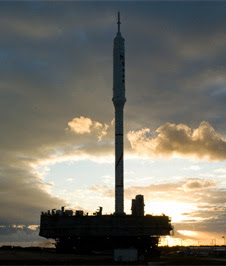
327-foot-tall Ares I-X rocketAres I-X has completed the first leg of its upcoming mission.

NASA's newest rocket -- currently the largest in the world -- emerged from the Vehicle Assembly Building at 1:39 a.m. EDT Oct. 20, 2009, beginning a 7.5-hour trek through the predawn darkness to Launch Pad 39B at Kennedy Space Center in Florida.

It's the first new vehicle to occupy Launch Pad 39B in more than 25 years.

The goal of the test is to give NASA the chance to see the Ares I flight hardware, facilities and launch procedures in action. With more than 700 sensors on board, Ares I-X is wired to relay ascent data that will be critical for future flights.

The 1.8-million-pound rocket stayed "steady as a rock" throughout the 4.2-mile journey, according to NASA's Jon Cowart, one of two Ares I-X deputy mission managers overseeing the assembly and launch.
Steep ladders mounted inside the upper stage simulator
"For those of us who've lived with the shuttle and grew up looking at the Saturn Vs, it's obviously a little different than what we're used to seeing," Cowart said as the tracked crawler-transporter carried the 327-foot-tall rocket and its mobile launcher platform to the top of the pad. The rocket's upper stage loomed high above the top of the pad's fixed service structure, surpassed only by the pad's three lightning masts.

Closer in height to the hulking Saturn V moon rockets than the space shuttle, Ares I-X looks unlike any rocket that's ever stood at Launch Complex 39. But it blends familiar hardware from existing programs with newly developed components.

Four first-stage, solid-fuel booster segments are derived from the Space Shuttle Program. A simulated fifth booster segment contains Atlas-V-based avionics, and the rocket's roll control system comes from the Peacekeeper missile. The launch abort system, simulated crew and service modules, upper stage, and various connecting structures all are original.

'We've Got a Rocket'

Ares I-X in High Bay 3
The fast-paced assembly sequence kicked off in late 2008, when flight hardware began arriving at the Florida spaceport from NASA field centers and contractors across the country.

In order to handle the influx of Ares I-X components, the processing team needed more room than the Vehicle Assembly Building's High Bay 3 and booster facilities could provide. So elements were stored, inspected, fitted or joined together in additional facilities across the space center, and even at the Astrotech Space Operations facility in nearby Titusville, Fla.

The simulated upper stage arrived in November 2008 aboard the Delta Mariner barge after a journey from NASA's Glenn Research Center in Ohio. In January 2009, a C5 cargo plane carried the full-scale crew module simulator and launch abort system from the agency's Langley Research Center in Virginia to Kennedy's Shuttle Landing Facility.

As assembly began, NASA Vehicle Processing Engineer Trent Smith was tasked with ensuring the work was done in the right order and that all necessary parts and personnel were available.

"When the hardware started showing up, I thought, 'Oh wow, it's here,' " Smith said. "We've got a rocket!"

Along with the crew module and abort tower, the upper stage's seven tuna can-shaped pieces, service module, spacecraft adapter and two interstage connectors were staged in the Vehicle Assembly Building's High Bay 4 prior to stacking.

The funnel-like frustum, forward skirt with its extension, and simulated fifth booster segment arrived from Indiana, where they were manufactured by Major Tool and Machine. First-stage prime contractor ATK Space Systems built the four solid-fueled booster segments, which reached Kennedy in March 2009 after a seven-day, cross-country train ride from Utah.

Stacking Begins

Smaller sections called "super stacks" were assembled first. The two interstage pieces, frustum, forward skirt and extension were mated to the simulated fifth booster segment in early July, completing Super Stack 1.

A day later, the aft, or bottom, segment of the first-stage solid booster rolled into the Vehicle Assemble Building and was secured to the mobile launcher platform in High Bay 3, marking the official start of final assembly.

"When we started stacking, it was a very big deal for us," Cowart said of the Ares I-X team. "We stacked all four of the boosters, then we were ready to bring over Super Stack 1."

Ares I-X finally was taking shape.

The first "tuna can" segment, comprising upper stage segment 1, was labeled Super Stack 2. Upper stage segments 2 through 5 made up Super Stack 3, and Super Stack 4 comprised upper stage segments 6 and 7. Segments 1 and 7 contain steel ballasts weighing a combined 160,000 pounds to mimic the weight of the Ares I liquid propellant tanks.

"I remember going up to Level 34 and looking down, and going on the E roof -- which is right about where the fifth segment simulator is -- and looking up, then down," Smith said. "That's when it really dawned on us that this is a tremendously tall rocket."

Barely five weeks after stacking began, Ares I-X was crowned with Super Stack 5, consisting of the launch abort system, crew module, service module and spacecraft adapter. The completed rocket towered above the surface of the mobile launcher platform, leaving only 10 feet of clearance for the heavy-lift crane to remove the birdcage-shaped framework that lowered the final pieces into place.

Assembly of the one-of-a-kind launch vehicle finally was complete. But plenty of work remained. The rocket was put through its paces: a power-up test, or "smoke test," to validate the electronics boxes and wiring; a "sway test" to check the vehicle's response to vibrations it could face during rollout; instrumentation tests; and a simulated countdown and liftoff.

Positioned for Launch

Once Ares I-X arrived at Launch Pad 39B, remaining milestones included a hot-fire of the rocket's auxiliary power units and checkout of the communications, instrumentation and telemetry. On launch day, most team members will be at their consoles seven hours before the opening of a four-hour launch window; Smith will ensure things are going well at the launch pad before retreating to a facility a safe distance away.

A successful liftoff will cap a demanding development and assembly process that Cowart believes illustrated NASA's entrepreneurial capability, as well as the dedication of the relatively small team that brought this flight from paper to reality.

Smith emphasized that the Ares I-X effort involved design centers, research centers, and multiple contractors -- all of which intersected at Kennedy.

"There was some education on all sides. Integrating and communicating were key to our success," he said. "What made it so rewarding was working through all the challenges and frustrations."

The Ares I-X flight test vehicle was still a concept about four years ago, Cowart pointed out.

"This is unprecedented in NASA history, for a rocket of this size," he said. "It's incredible."