Thursday, May 26, 2011

50 Years After Kennedy's Speech, Mars Mission Still Distant

Mars Mission
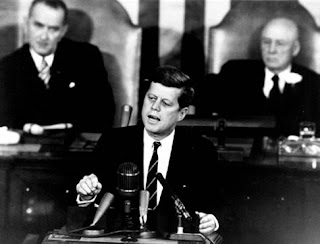
Today, May 25th, marks the 50th anniversary of President John F. Kennedy's famous speech challenging the U.S. to shoot for the moon, saying,"I believe that this nation should commit itself to achieving the goal, before this decade is out, of landing a man on the moon and returning him safely to Earth."

On May 25th, 1961, Kennedy's delivered the address on "Urgent National Needs" to Congress a mere six weeks after the Soviet Union sent Yuri Gagarin on the first human spaceflight on April 12 and twenty days after Alan Shepard's first American flight on May 5th.

The result of Kennedy's challenge was the Apollo program, which sent America and mankind on a journey that's still soaring to new heights.

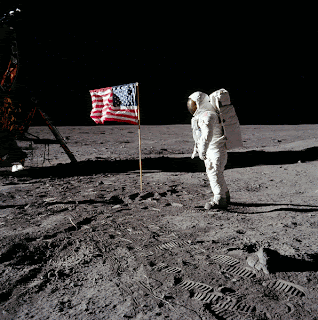
Kennedy's goal was fulfilled on July 20, 1969, when Apollo 11's lunar module Eagle touched down in the Sea of Tranquility, with Neil Armstrong and Buzz Aldrin aboard. Before the Apollo program ended in 1972, six missions landed on the moon and a dozen men set foot on its pale, mysterious crust.

Fifty years after Kennedy urged America to take one giant leap for mankind, we've accomplished unimaginable achievements, launching space shuttles, landing robotic rovers, traveling all the way to Jupiter, and building space stations.

After all of our exploration, we are still fascinated by the moon though. NASA continues to study it with satellites images, and in October of last year, NASA discovered large amounts of water and ice on the moon.

Read More

Tuesday, May 24, 2011

Spirit's Mars mission comes to a close

Mars
It's been a year since the rover sent a signal. After Tuesday, NASA scientists will stop trying to send it commands. Its twin, Opportunity, continues to work 7 years into what was to be a 3-month mission.

After a year of fruitlessly trying to communicate with Spirit, one of two rovers on the surface of Mars, NASA scientists have finally decided to let it rest in peace. They plan to send their last commands to the rover a little after midnight Wednesday.

Spirit, which landed on Mars in January 2004, has been stuck in Martian sand for two years and has been silent for more than a year, despite regular attempts by NASA scientists to contact it.

Along with its twin rover Opportunity, which landed on the opposite side of the planet, it was sent to explore the Martian landscape for about three months. Yet although they were not built to survive the planet's harsh winters, the two have far outlived their life expectancies and their mission has proven wildly successful, sending back strong evidence, for example, that water once shaped Mars' surface.

Read More

Monday, May 23, 2011

Race to Space, Through the Lens of Time


It was the spring of 1961. President John F. Kennedy, speaking of new frontiers and projecting the vigor of youth, had been in office barely four months, and April had been the cruelest.

On the 12th, Yuri Gagarin became the first human to orbit Earth — one more space triumph for the Soviet Union. Though the flight was not unexpected, it was nonetheless deflating; it would be more than a month before Alan Shepard became the first American in space, and that was on a 15-minute suborbital flight. On the 17th, a force of anti-Castro exiles, trained by the C.I.A., invaded communist Cuba at the Bay of Pigs — a fiasco within 36 hours. Mr. Kennedy’s close aide Theodore Sorensen described him on the 19th as “anguished and fatigued” and “in the most emotional, self-critical state I had ever seen him.”

At one meeting, his brother Robert F. Kennedy, the attorney general, “turned on everybody,” it was reported, saying: “All you bright fellows. You got the president into this.

Read More

NASA Plans Test of New Moon Lander Morpheus

Moon Lander Morpheus
A squat, insectlike contraption is set to fly untethered for the first time soon in a NASA test of technologies designed to take humans to the moon, Mars or beyond.

The unmanned Morpheus lander, named after the Greek god of dreams, was built at NASA's Johnson Space Center in Houston using cutting-edge technologies that the agency hopes will one day enable manned missions to another planet or even an asteroid. The vehicle, about the size of an SUV, could carry about 1,100 pounds (500 kg) of cargo to the moon.

Not only are the technologies onboard innovative, but NASA's process of building the lander is, too.

"Part of what this project set out to do was to question the way we've done things," Project Morpheus manager Matt Ondler told SPACE.com. "We purposefully set out to see if we could do things faster and cheaper, leveraging off the work that was already done."

So far, the project has cost NASA about $4 million over the last 18 months, not counting the NASA work force, which is accounted for under NASA's general overhead.

Read more:

Thursday, May 12, 2011

Sky spy: Watch the ongoing predawn show

moon
The moon rises at 2:14 p.m. this afternoon and sets at 2:29 Friday morning. It is a gibbous (more than half lit) moon that is waxing (growing larger) toward full moon next Tuesday.

It is a good time to look at the moon with binoculars or a small telescope. The large dark areas on the moon are called maria (mare singular) which means sea in Latin.

The early telescopic observers of the moon in the 1600s thought the dark areas were large bodies of water. We now know they are cooled lava beds leftover from vast volcanic eruptions on the moon 3 to 4 billion years ago.

In contrast to the maria are white or gray regions, which are highlands containing mountains, plains, and valleys. Craters are scattered all over the moon, and the southern portion of the moon, the southern highlands, is heavily covered with crater- speckled mountains and hills.

Don't forget about the ongoing planetary show in the predawn morning sky. Sometimes the best sky shows happen at the most inconvenient times.

Sunrise is at 5:27 Friday morning. A good way to start off Friday the 13th is to rise early and look at the eastern sky starting at 4:50 a.m. Get a low, unobstructed horizon. Brilliant Venus will catch your eye. Just above Venus will be Jupiter and just below Venus will be Mercury. A little off to the left (north) will be Mars.

Read More

Wednesday, May 11, 2011

Dawn Planetary Delights

Planets Get Closer
During the month of May, four bright Planets will grace the morning sky just before dawn.

The planets Venus, Jupiter, Mercury and Mars will be involved in a series of conjunctions (close together) and will finally be joined by the thin crescent moon at the end of the month.

Twice during May some of the planets will converge to form a trio, where 3 planets will fit in an imaginary circle roughly 5 degrees across.

On the 11th Mercury, Venus and Jupiter will be within 2.5 degrees of each other, forming a very tight trio and on the 21st another trio will be formed by Mercury, Venus and Mars.

On the 29th, 30th, and 31st, the waning crescent moon will arrive, moving past Jupiter, Mars, Venus and Mercury stretched out in a line across the eastern sky.

Read More

Monday, May 09, 2011

NASA considers Mars and Titan probes

Mars and Titan probes
NASA said Friday it will choose its next mission from among studies of the inside of Mars, a sea on a moon of Saturn or a comet's nucleus.

Teams will get $3 million apiece to sketch out each mission, and one will be chosen for a 2016 launch, the space agency said.

The winning project is to cost no more than $425 million, not counting the cost of the launch vehicle.

One option, the Geophysical Monitoring Station, would study the structure and composition of the martian interior.

The Titan Mare Explorer would carry out the first direct exploration of an extraterrestrial ocean by landing in and floating on a methane-ethane sea on that moon of Saturn.

The Comet Hopper probe would study comet evolution by landing on a comet repeatedly and observing its changes during its course around the sun.

Meanwhile, the European Space Agency said Friday images from its Mars Express show a system of deep fractures in the crust around the Isidis impact basin. Some of the cracks are 1,600 feet deep

Read more:

Thursday, May 05, 2011

WVU Students Builds Robot for the Moon

Moon Robot
A group of WVU students is building a robot that can work on the moon.

A lunabotics team of 15 engineering students is competing in NASA's second annual Lunabotics Mining Competition. They're designing a remote controlled excavation robot capable of collecting and depositing simulated moon soil.

The students say technology like this will make sustainable human settlement on the moon and Mars a possibility.

"The idea being that we are going to put robot's in place of astronauts, and so we wanna create the first wave of that lunar colonization for their exploration. It's just a really neat thing," said lunabotics team member Ben Knabenshue.

The WVU/NASA space grant consortium is sponsoring the project.

Former astronaut and WVU alum Jon McBride is advising the team.

Read More

Tuesday, May 03, 2011

Is our space vision still shortsighted?

Moon and Mars
Two years ago, retired aerospace executive Norman Augustine headed up a commission that led the White House to scrap NASA's "unexecutable" back-to-the-moon program and focus instead on a step-by-step path to send humans beyond Earth orbit, to an asteroid by 2025, and to the environs of Mars by the 2030s.

Now NASA is nearing the end of the shuttle program, gearing up to mark Thursday's 50th anniversary of U.S. human spaceflight ... and dealing with an uncertain future for human spaceflight. Augustine says NASA is mostly following the short-term prescription he and his colleagues have laid out, but he worries that NASA's long-term future could be a case of deja vu all over again.

In an interview, Augustine told me that NASA could once again face a situation where its budget doesn't match the task it's been given. The current year's $18.45 billion budget is a bit less than last year's, and includes $3 billion for work on a heavy-lift rocket and a spaceship that could eventually go beyond Earth orbit.

Read More

Monday, May 02, 2011

Students illustrate their ideas of space travel

Space Travel
Space exploration may include a base on the moon or large airplane-like transporters, according to the artistic creations of Orangeville Christian School students.

A group of seven students — the gifted class — recently learned all three of their entries in a competition held by the International Academy of Astronautics finished high in the rankings. As such, their works were put on display for space travelers, scientists and others during the Humans in Space Symposium in Houston, Texas April 11 to 15.
“I’m super excited for them,” teacher Vicki Marcus said. “I’m very proud of them.”

Under the guidance of Marcus and Laurie Smith, owner of Z’Arts Studio in Hockley Valley, the students researched and drafted their ideas on computers last fall. They then printed them on canvas and finished them with acrylic paints.

Sunday, May 01, 2011

Dry ice hints at 'Dust Bowl' on Mars

Dry Ice on MARS
Think Mars today is a hostile place? It was worse 600,000 years ago, according to new research that suggests the planet had a dustier, stormier atmosphere.

"It was an unpleasant place to hang out," said lead researcher Roger Phillips of the Southwest Research Institute in Texas. He said Mars' climate was probably something like the American Dust Bowl of the 1930s - but a lot worse.

The evidence comes from the discovery of a huge underground reservoir of dry ice, or frozen carbon dioxide, at its south pole - much more than scientists realized. They suspect some of that store of carbon dioxide was once in Mars' atmosphere, making it denser.

In the recent geologic past, when Mars' axis tilted, sunlight reached the southern polar cap and melted some of the frozen carbon dioxide. This release would have made the atmosphere thicker and caused more dust to loft into the air, creating severe storms. Other times, carbon dioxide cycled back into the ground as part of a seasonal cycle.

Read more:

Friday, April 29, 2011

China to send men to moon and Mars

China Moon and Mars
Announced earlier in the week, the station will weigh 60 tons; about one seventh of the mass of today's International Space Station. Unmanned, its first module should be launched later this year, and then hooked up to two following manned modules. Participating in the briefing, astronaut Yang Liwei admitted the Center's engineers were finding the development of sophisticated docking technology, needed to create the country's first multi-module spaceship, to be a challenge.

"In 2003 China became the third nation to put a man into space. The first Chinese space walk followed five years later in 2008."

Looking ahead, China wants to put a man on the moon by 2025 and then send a man to Mars before the year 2060. Of course the dream does not end there.

Read More

Thursday, April 28, 2011

Fill 'er up at an interstellar gas station

Gas Station
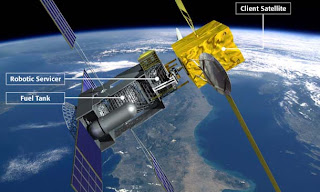
A spaceship isn't much use if it doesn't have the juice to go somewhere. And if you're an astronaut bouncing around destinations like the moon, random asteroids, Lagrange points, and Mars, you'll probably need an interstellar gas station.

NASA has launched an "In-Space Cryogenic Propellant Storage and Transfer Demonstration Mission Concept (PDF)" study, which is essentially a call for scientific institutions around the globe to help create a space gas station. Those wishing to build a fueling stop in the sky have until May 23 to submit their proposals.

Cryogenic propellants used in rocket engines are usually made of liquid hydrogen and liquid oxygen. Both liquids reside in enormous insulated containers and are pumped through an expansion chamber, then mixed and ignited in the combustion chamber. The result is an incredible amount of power per gallon of cryogenic proellant, up to 40 percent higher than other rocket fuels.

However, there are many challenges to creating a gas station in the stars. The primary objectives of the study are to address key elements including a fail-safe way to transfer the propellants from a storage container to a ship. The difficulty is high since hydrogen tends to leak (it's the smallest element), and can eventually deteriorate the container it's stored in.

Read more:

Wednesday, April 27, 2011

What China's New Space Station Means For The World

China's new space station
China is launching its very own space station. Countries have achieved such a feat absent international cooperation only twice before--Russia's Salyut, in 1971, and the United States' Skylab, in 1973. After successful manned space flights and a robotic lunar lander, a space station would be a potent political symbol in an era when the U.S. has no means to get astronauts into space other than paying the Russians.

Because its space program is a subsidiary of the People's Liberation Army, some have concluded that China's designs on space are military, but thoughtful observers disagree: the association between the country's space exploration program and the PLA is about the past, not the future. Chinese lasers won't be raining down on us from space any time soon. The future of China's space program is not about weapons, it's about putting a Chinese man on the moon.

The thing about China--a nation led by engineers--is that through the vehicle of its 5-year plans, its government methodically pursues its stated goals. It's happened before in microchips, leading the Chinese government to develop a home-grown processor that may some day challenge Intel. And it's happening in space.

Human space exploration requires mastery of a succession of tasks: getting a human home from space safely. Spacewalks. Docking in orbit. Living in space for extended periods. The Chinese space program has accomplished all of these goals except the last; the space station completes the country's maturation as the world's current leading space power. The step beyond this program program would be the most public and visible demonstration imaginable of the country's ascendancy: it would mean reproducing the United States' most singular moment of scientific and military triumph, a boot-print on lunar soil.

Read More

Tuesday, April 26, 2011

NASA’s Human Spaceflight Dying & Only Mars Can Save It

Mars
The greatest adventure in human history is ending in its infancy. NASA’s human spaceflight program, a signature achievement of American civilization, is dying. NASA succeeded, landing Neil Armstrong and Edwin (Buzz) Aldrin on the lunar surface only 98 months after Kennedy inspired the nation with his vision.

The program was conceived during the bleak days following Russia’s launch of Sputnik in 1957, and then was energized by President John F. Kennedy’s proposal in 1961 to put astronauts on the Moon by decade’s end.

If you grew up during that decade (as I did) and heard the bold rhetoric about new frontiers and carrying freedom’s message into the cosmos, you couldn’t help but be moved. America had a sense of mission back then that is largely missing from political discourse today, and the human spaceflight program epitomized the hopes of a new generation for the future.

It is unsettling to see how our confidence has shriveled during the intervening years, both at NASA and in the broader political culture. At NASA, the Space Shuttle program is about to shut down and the Constellation program conceived to replace it with manned missions to the Moon and Mars has been canceled by the Obama Administration.

What remains of the human spaceflight program looks unlikely to survive an era of budget cutting and cultural pessimism.

Read More

Monday, April 25, 2011

Will humans make it to the moon and Mars in 10 years?

moon and mars base
In just the past week, Congress has introduced a bill directing NASA to put a manned base on the moon by 2022, and SpaceX founder Elon Musk has said that he'll be sending humans to Mars in a little as 10 years. But can it happen, and do we even want it to?

The "Reasserting American Leadership in Space Act" would tell NASA to "develop a sustained human presence on the moon in order to promote exploration, commerce, science and United States preeminence in space as a stepping stone for the future exploration of Mars and other destinations," all by 2022. That sounds good in theory, but the bill basically just says, "Hey, go do this," without recognizing that it may be both a technologically and fiscally impossible task for NASA to accomplish within that time frame.

Private industry is rapidly catching up to NASA. In the next ten years especially, the space agency seems likely to get eclipsed after the impending retirement of the space shuttle. SpaceX might have the credentials to back up its space exploration plans, which would put humans on Mars in a decade if everything goes well. That's a big if, though, since SpaceX still has a lot of work to do to get its Falcon heavy-lift rocket operational by 2012.

Read More

Shooting for the moon amid cuts

Nasa
For all the rhetoric about cutting government spending, NASA’s space mission remains sacred in Congress.

A handful of powerful lawmakers are so eager to see an American on the moon — or even Mars — that they effectively mandated NASA to spend “not less than” $3 billion for a new rocket project and space capsule in the 2011 budget bill signed by the president last week.
NASA has repeatedly raised concerns about the timeframe for building a smaller rocket — but the new law expresses Congress’s will for the space agency to make a massive “heavy-lift” rocket that can haul 130 metric tons, like the ones from the days of the Apollo.

Congressional approval of the plan — all while $38 billion is being cut elsewhere in the federal government — reflects not only the power of key lawmakers from NASA-friendly states, but the enduring influence of major contractors like Lockheed Martin and Boeing in those states.

For instance, a series of stop-gap spending laws had kept money flowing to the man-to-moon Constellation program because Sen. Richard Shelby (R-Ala.) initially tucked a provision into a 2010 budget bill — even though President Barack Obama and Congress agreed last fall to end that Bush-era initiative. An internal NASA audit pegged the cost of that move at $215 million over five months.

Read more:


Thursday, April 21, 2011

One Possible Small Step Toward Mars Landing: A Martian Moon

moon
This picture of Phobos shows two possible landing sites for the Russian Phobos-Grunt mission. The oval in red marks a spot that was previously being considered, while the blue oval denotes the currently favored landing site.

The two moons of Mars, Phobos and Deimos, are in the sights of planners of both human and robotic spaceflights.

Last year NASA began targeting a mission to Mars, as decreed by President Barack Obama. "By the mid-2030s, I believe we can send humans to orbit Mars and return them safely to Earth. And a landing on Mars will follow. And I expect to be around to see it," he said in April 2010 during an address at NASA's Kennedy Space Center in Florida.

In response, one idea now percolating within the space engineering community has been scripted by Lockheed Martin Space Systems. The company near Denver has taken a longing look at its own Orion spacecraft under development and missions beyond low-Earth orbit. A result is a proposed mission called Project Red Rocks to explore the outermost moon of Mars, Deimos, as the penultimate step toward setting human foot on the Red Planet.

Read More

Tuesday, April 19, 2011

Why Is It So Hard to Travel to Mars?

Mars
The Challenger and Columbia space shuttle disasters were perhaps two of the most prominent reminders of how crucial it is that everything work just right for a spacecraft to travel to space and successfully return back to Earth.

Whether it was the failure of the seal used to stop hot gases from seeping through, or a piece of foam insulation that damaged the thermal protection system, scientists and engineers must make thousands of predictions of all the things that could go wrong during flight.

NASA's human Mars mission presents even more challenges of sending humans safely to a farther distance and to a more dangerous environment. Designing an aircraft that can safely enter and exit Mars' unpredictable atmosphere is a big challenge.

"Each time we fly to Mars, we learn a little more and get a little smarter," said Walter Engelund of NASA's Langley Research Center. "One thing we have learned is that the Mars atmosphere is certainly a big variable. It is much more dynamic than our own Earth's atmosphere."

Read More

Monday, April 18, 2011

Yuri Gagarin From the Earth to Mars Tribute

Yuri Gagarin
50 Years ago, the dream of human spaceflight opened with the courageous blastoff of Cosmonaut Yuri Gagarin inside the Vostok 1 spacecraft on April 12, 1961. Gagarin was the first person to orbit the Earth. Less than a month later on May 5. 1961, Astronaut Alan Shepard bravely set forth on America’s first human spaceflight – Freedom 7.

Barely three weeks afterward on May 25, 1961, these momentous events of the early Space Age led directly to Project Apollo and the historic announcement by President Kennedy that the United States “would land a man on the moon” by the end of the 1960’s.

In honor of Yuri Gagarin, NASA’s Opportunity Mars Rover explored a small and highly eroded crater dubbed “Vostok Crater” in 2005 during its journey in the Meridian Planum region on the Martian surface. Along the edge of the crater, researchers commanded Opportunity to use the Rock Abrasion Tool (RAT), to drill into a rock dubbed “Gagarin” on Sols 401 and 402 in March 2005.

Read More

North-East firms helped Nasa shoot for the moon

Moon
Yuri Gagarin became one of the most famous men on the planet when he orbited the Earth in Vostok 1, on April 12, 1961. Just over a month later, US President John F Kennedy, determined to regain the initiative for his country, told Congress: "I believe that this nation should commit itself to achieving the goal, before this decade is out, of landing a man on the Moon and returning him safely to the Earth."

Unbeknown at that time, foundations had been laid in the North-East to play a significant role in that adventure.

Some 35 years earlier, a young apprentice, Francis Thomas Bacon, had joined one of the North-East's largest employers, steam turbine builder CA Parsons, in Newcastle.

While at the firm, where he worked from 1925 to 1940, he became interested in the potential of fuel cells, devices using hydrogen and oxygen to produce electricity, for pollution-free power.

As its commercial value wasn't then recognised, he initially began carrying out experiments at the firm in secret, unaware that his work was to play an integral part in putting Apollo 11 and US astronaut Neil Armstrong on the moon in 1969.

Read More

Friday, April 15, 2011

Russia's President Announces Plan for Moon Base

Moon Base
This week marks the 50th anniversary of one of the most significant milestones in the “Space Race” between the United States and the Soviet Union, and it comes at a time when Russia once again hopes to sprint head of any rival space program.
On April 12, 1961, Yuri Alekseyevich Gagarin became the first human being to enter space and orbit the Earth. (Alan Shepard’s suborbital flight a few weeks later marked the first flight of an American in space.) The 50th anniversary of Gagarin’s flight is a reminder that at several occasions during the early years of the “Space Race,” the Soviets were in the lead; for example, in addition to the milestone of launching the first man into space, the U.S.S.R. also launched the first satellite — Sputnik 1 — on October 4, 1957 and the first space station in April, 1971, and one of its astronauts conducted the first space walk on March 18, 1965.

After the arrival of Apollo 11 on the moon’s surface on July 20, 1969, many of the earlier Soviet successes were forgotten. Gagarin had died the previous year, when his MiG 15 training jet crashed. In the general concensus, America had “won” the space race.

Now, as Russia marks the 50th anniversary of Gagarin’s historic flight, there may be grounds for reevaluating that assessment. President Obama has fundamentally altered the role of NASA in the future of manned space flight, even as private companies are independently developing launch vehicles that could serve a wide variety of private or public missions. (In fact, SpaceX recently announced it plans to build the large booster since the Apollo program’s Saturn V.)

Read More

Students to Design Rovers with NASA

rover
The National Aeronautics and Space Administration (NASA) announced the selection of 80 students from 28 community colleges across the United States and Puerto Rico to participate in the National Community College Aerospace Scholars program. In a press release from NASA on April 7, 2011, the agency unveiled details about the program which is intended to encourage students to pursue careers in the STEM (Science, Technology, Engineering and Mathematics) disciplines.

The students were selected based on participation and completed assignments in an on-line program which was conducted during the school year. The chosen students will participate in the program at the Jet Propulsion Laboratory in Pasadena, California on April 27-29 or at the Johnson Space Center in Houston, Texas on May 12-14 this year.

The students will be separated into teams as hypothetical companies pursuing the exploration of Mars. The students will experience many of the challenges and use methods employed by actual scientists and engineers of the agency. The students will also be responsible for developing the company infrastructure as well as designing and creating a prototype rover for use on the planet

Read More

Wednesday, April 13, 2011

Earthlings, let's now tap Moon & Mars

Moon
Rakesh Sharma, India's first cosmonaut, remembers his time in space and his training in Russia on the 50th anniversary of Yuri Gagarin's maiden space voyage.
Half a century ago, the 27-year-old Soviet cosmonaut Yuri Gagarin created history by becoming the first man to journey into space. As Russia and the world celebrate the 50th anniversary of the first manned space-flight by Gagarin, it’s important to remember that it was not only a giant leap for mankind, but also marked an all-time high for the Soviet patriotic pride in the Cold War period. In essence, April 12 was not only the day when mankind achieved what was previously thought impossible, but also the culmination of decades of Soviet space research that had already launched the first satellite in October 1957, the first animal to orbit the Earth (Laika, the dog) in November 1957, and numerous other milestone flights and satellites.

Gagarin’s flight was, importantly, one of the biggest ‘victories’ for the Soviet Union in the Cold War Soviet-U.S. Space Race – a fierce contest for supremacy in outer space exploration. In other words, this was a battle of giant egos and both countries burned millions of dollars in research to be the first to conquer some tiny part of the final frontier.

Read More

Tuesday, April 12, 2011

50 years after Yuri, India still on its slow climb

Rakesh Sharma
At a time when the world is set to raise a toast to Yuri Gagarin on the 50th anniversary of his trail-blazing flight into space, Indian cosmonaut Wing Commander Rakesh Sharma has one lament: a holdup in the indigenous human spaceflight programme.

The cosmonaut, is disappointed with what he described as a “cooling off” of the programme after its launch in 2007. “The reverses must be addressed and the rocket should be man-rated (certified safe for humans) by Isro,” he told Deccan Chronicle.

His disappointment with the slow progress of the programme comes at a time when China is stepping up its space missions with an orbiting space lab, to be launched later this year. Weighing nearly 19,000 lbs, the unmanned Tiangong 1 module will be launched aboard a Long March 2F rocket from Jiuquan space centre in the Gobi desert.

As space buffs across the world celebrate the 50th year of Yuri Gagarin's trail-blazing flight into space, scientists and cosmonauts are set to chant the icon’s call “Poyekhali,” or “here we go” and advance from an era of voyages of discovery, to voyages of profit.

Their ambitions are soaring beyond the Moon and Mars — not merely for science, symbolism and glamour — but for the benefit of humankind. Energy from space, efficient methods of identification and management of water resources, and fail-safe security systems for every nation, will be within reach. For once, sci-fi writers could be proved right, albeit through a joint effort, circa 2030.

Read More

Monday, April 11, 2011

Soviet feat in 1961 started race to moon

Moon
STAR CITY, Russia - It was the Soviet Union's own giant leap for mankind, one that would spur a humiliated America to race for the moon. It happened 50 years ago Tuesday, when an air force pilot named Yuri Gagarin became the first human in space.

The 27-year-old cosmonaut's mission lasted just 108 minutes and was fraught with drama: a break in data transmission, glitches involving antennas, a retrorocket and the separation of modules. And there was an overarching question that science had yet to answer: What would weightlessness do to a human being?

"There were all kinds of wild fears that a man could lose his mind in zero gravity, lose his ability to make rational decisions," recalls Oleg Ivanovsky, who oversaw the construction and launch of the Vostok spacecraft that carried Gagarin.

The flight went off safely, and the handsome Russian with the big smile became a poster boy for the communist world, still a national idol 43 years after his death in a jet training accident, and remembered with affection by the last surviving pioneers of the Soviet space program.

From chief designer Sergei Korolyov to young nurses and rank-and-file launch pad workers, "people loved, really loved him," Ivanovsky said in a telephone interview.

Gagarin's rocket lifted off as scheduled on April 12, 1961, at 9:07 a.m. Moscow time.

Read More

Sunday, April 10, 2011

Volcanoes Reveal the Cooling of Mars

The mantle of Mars is possibly cooling by 30-40°C every billion years. Based on satellite observations of the composition of the planet's volcanic rocks, researchers from CNRS and the Université Paul Sabatier in Toulouse reached this conclusion after reconstructing for the first time the thermal evolution of the planet over the past 4 billion years. These values indicate that cooling is slower than on Earth and highlight the specific nature of our planet, where thermal evolution is affected by plate tectonics. These findings were recently published in the journal Nature.

The history of water and of climate evolution on Mars has received considerable attention over the past few decades. However, the evolution of a planet needs to be considered in its entirety. This requires an understanding of the thermal and dynamic evolution of the planetary interior in relation to volcanic or tectonic activity.

Thursday, April 07, 2011

How NASA will land a rover on Mars


NASA has produced an animated video explaining how it will send the 'Curiosity' rover to Mars. The five-minute clip shows a NASA spacecraft falling through the atmosphere of the Red Planet, and a floating crane depositing the 3-meter rover onto Mars' rocky surface. (See it for yourself below.) The video is meant to reflect the "dynamic, violent nature of landing on another planet," says Doug Ellison, a member of the animation team. Curiosity is expected to touch down on Mars in August 2012. It will take samples and atmospheric readings from the Martian soil, and attempt to answer the question: Is there life on Mars?

Huge Private Rocket Could Send Astronauts to the Moon or Mars

rocket
A massive new private rocket envisioned by the commercial spaceflight company SpaceX could do more than just ferry big satellites and spacecraft into orbit. It could even help return astronauts to the moon, the rocket's builder says.

SpaceX announced plans to build the huge rocket, called the Falcon Heavy, yesterday (April 5). To make the new booster, SpaceX will upgrade its Falcon 9 rockets with twin strap-on boosters and other systems to make them capable of launching larger payloads into space than any other rocket operating today.

But the Falcon Heavy's increased power could also be put toward traveling beyond low-Earth orbit and out into the solar system, said SpaceX's founder and CEO Elon Musk during a Tuesday press conference
"It certainly opens up a wide range of possibilities, such as returning to the moon and conceivably going to Mars," Musk said.

Traveling that far requires more lift than most rockets flying today, including NASA's space shuttle. But the Falcon Heavy, which is designed to generate 3.8 million pounds (1,700 metric tons) of thrust, would be able to do the job, Musk said.

Read More

Tuesday, April 05, 2011

Marvelous views of Saturn

Saturn
When Saturn reaches astronomical opposition, we’ll be treated to some marvelous views of the ringed and gaseous planet as it stands opposite the sun, from Earth’s perspective. In other words, when Saturn ascends the eastern sky at dusk, the sun will be setting in the west.
Think about this concept: When the moon is full from Earth’s perspective, the moon is opposite the sun. On the evening of a full moon, the lunar orb rises in the east at dusk while the sun sets in the west. It’s the same for Saturn and the sun.

With clear skies at night, Saturn loiters in the constellation Virgo at sundown, near the star Spica. This planet becomes a beacon to find at zero magnitude, which is bright enough to see from urban, light-polluted locations. Through April, it generally remains visible all night long.

Saturn gets a cosmic weekend guest, as the waxing moon approaches it April 16. Find the official full moon April 17, when it becomes this celestial body’s turn to sit opposite the sun.

Read More

Monday, April 04, 2011

Hot then cold, ready for your close up, Mr Mercury

Mercury
He's really hot, really cold, maybe even a bit icy. He is the planet Mercury and this month he is ready for his extended close-up.

On Wednesday, NASA showed the first pictures taken by its Mercury Messenger spacecraft, which entered the planet's orbit on March 17.

Messenger will spend at least a year photographing, measuring and studying Mercury, which for now is the last frontier of planetary exploration.
Advertisement: Story continues below

''This is the last of the classical planets, the planets known to the astronomers of Egypt and Greece and Rome and the Far East,'' the principal investigator, Sean Solomon of the Carnegie Institution of Washington, said.

It ''captivated the imagination and the attention of astronomers for millennia'', Dr Solomon said, but science had never had such a front-row seat. ''We're there now.''

The space agency has sent orbiters to five planets - Mercury, Venus, Mars, Jupiter and Saturn - but it probably will take a decade or two before a spacecraft orbits Uranus or Neptune. (In 2015, NASA's New Horizons spacecraft will zoom past Pluto - which is no longer regarded as a planet.)

Half a dozen fly-bys by NASA probes - three by Mariner 10 in the 1970s and three by Messenger in the past three years - have seen Mercury close up, though briefly.

Read More

Friday, April 01, 2011

NASA Airborne Radar Set to Image Hawaiian Volcano


The Kilauea volcano that recently erupted on the Big Island of Hawaii will be the target for a NASA study to help scientists better understand processes occurring under Earth's surface. A NASA Gulfstream-III aircraft equipped with a synthetic aperture radar developed by NASA's Jet Propulsion Laboratory in Pasadena, Calif., is scheduled to depart Sunday, April 3, from the Dryden Aircraft Operations Facility in Palmdale, Calif., to the Big Island for a nine-day mission.

The Uninhabited Aerial Vehicle Synthetic Aperture Radar, or UAVSAR, uses a technique called interferometric synthetic aperture radar that sends pulses of microwave energy from the aircraft to the ground to detect and measure very subtle deformations in Earth's surface, such as those caused by earthquakes, volcanoes, landslides and glacier movements. As the Gulfstream-III flies at an altitude of about 12,500 meters (41,000 feet), the radar, located in a pod under the aircraft's belly, will collect data over Kilauea. The UAVSAR's first data acquisitions over this volcanic region took place in January 2010, when the radar flew over the volcano daily for a week. The UAVSAR detected deflation of Kilauea's caldera over one day, part of a series of deflation-inflation events observed at Kilauea as magma is pumped into the volcano's east rift zone.

The astronauts of planet Earth

Moon
In the 50 years since Yuri Gagarin first soared into space, 520 men and women have taken their own space odysseys. They have come from 38 countries, carried on American, Russian and, recently, Chinese vehicles. All have been proud to represent their nations. Now, in a special issue honouring their achievements, FT Weekend Magazine has interviewed an astronaut from 35 of these countries. The project involved 17 writers, 11 languages and a rather flustered mission control – but it resulted in stories as diverse and entertaining as the voyagers themselves. May we present … the astronauts of Planet Earth.

The human history of space began on the morning of April 12 1961. After a breakfast of meat paste and marmalade, squeezed from a tube, a 27-year-old lieutenant in the Soviet air force, Yuri Alekseyevich Gagarin, was helped into a bulky orange flying suit. With his back-up, Gherman Titov, he was driven in a bus to a launch pad on the desolate Tyuratam missile-testing site on the steppes of Kazakhstan. According to Soviet lore, Gagarin then gave a short speech to the crowd of engineers, scientists and mechanics gathered in the early morning sunshine. “Dear friends,” he began. “What can I tell you in these last minutes before the launch? My whole life appears to me as one beautiful moment. All that I previously lived through and did, was lived through and done for the sake of this moment.”

Those words, written for Gagarin, had actually been recorded in Moscow. On the morning of his flight, he simply said goodbye, clanked helmets awkwardly with Titov, and was then taken up and strapped into a small spherical pod attached to a 300-tonne rocket that had been designed to carry nuclear weapons. For the next two hours, as the scientists fussed and took tranquilliser pills, Gagarin became slightly bored and asked for some music to be piped in. He said the first, true human words of a cosmonaut as his Vostok “satellite-ship” began to rise from the earth at 9.06.59am, his heart beating almost three times a second: “Let’s go!”

Read More

Thursday, March 31, 2011

MESSENGER Images from Orbit of Mercury-NASA Information


MESSENGER has delivered its first image since entering orbit about Mercury on March 17. It was taken today at 5:20 am EDT by the Mercury Dual Imaging System as the spacecraft sailed high above Mercury’s south pole, and provides a glimpse of portions of Mercury's surface not previously seen by spacecraft. The image was acquired as part of the orbital commissioning phase of the MESSENGER mission. Continuous global mapping of Mercury will begin on April 4.

“The entire MESSENGER team is thrilled that spacecraft and instrument checkout has been proceeding according to plan,” says MESSENGER Principal Investigator Sean Solomon, of the Carnegie Institution of Washington. “The first images from orbit and the first measurements from MESSENGER’s other payload instruments are only the opening trickle of the flood of new information that we can expect over the coming year. The orbital exploration of the Solar System’s innermost planet has begun.”

Wednesday, March 30, 2011

NASA's Mars Rover Goes Silent After Getting Stuck in Sand Trap

rover
One of NASA's Mars Rovers is no longer responding, and NASA is thinking about calling it quits and leaving it in the sandy bed.

NASA said it will make one last effort before ditching all efforts to “wake-up” the Mars Rover “Spirit.” Spirit fell silent nearly a year ago, and NASA engineers believe something is seriously wrong with Spirit— something more than just a power issue.

Spirit, a solar-powered Rover, sunk into a sand trap in 2009 during a routine drive. NASA attempted to wiggle it free, but Spirit remained stuck. And since it was unable to tilt itself toward the sun, the Rover went into hibernation.

NASA engineers had expected the rover to “wake up” once there was maximum sunlight filtrating the location where it's trapped, but that moment came and went earlier in March, and Spirit remained silent.

Read More

Tuesday, March 29, 2011

NASA scraps plan for 3D camera on Mars Rover

MARS
NASA has given up on the hope to build a 3D camera for the next robotic rover that the space agency will send to Mars.

Time simply ran out on efforts to develop the system and get it sufficiently tested before the Mars Science Laboratory rover, which has been dubbed Curiosity, is scheduled to launch later this year.

Movie director James Cameron, of Avatar and Titanic fame, has been helping to build the new camera, which would have both zoom and 3D capabilities.

Cameron has been working with Malin Space Science Systems of San Diego to build what would have been a 3D upgrade to the camera, dubbed Mastcam, already installed on Curiosity.

"With the Mastcam that was installed last year and the rover's other instruments, Curiosity can accomplish its ambitious research goals," Mars Science Laboratory Project Scientist John Grotzinger said in a written statement.

"The possibility for an upgrade was very much worth pursuing, but time became too short for the levels of testing that would be needed for them to confidently replace the existing cameras," Grotzinger.

Read More

Monday, March 28, 2011

Water-Powered Spaceship Could Make Mars Trip on the Cheap

water space craft
Spaceships powered primarily by water could open up the solar system to exploration, making flights to Mars and other far-flung locales far cheaper, a recent study has found.

A journey to Mars and back in a water-fueled vehicle could cost as little as one space shuttle launch costs today, researchers said. And the idea is to keep these "space coaches" in orbit between trips, so their relative value would grow over time, as the vehicles reduce the need for expensive one-off missions that launch from Earth.

The water-powered space coach is just a concept at the moment, but it could become a reality soon enough, researchers said. [Video: Space Engines: The New Generation]

"It's really a systems integration challenge," said study lead author Brian McConnell, a software engineer and technology entrepreneur. "The fundamental technology is already there."

Read more:

Friday, March 25, 2011

What's next for NASA: A new space shuttle? A mission to Mars?

NASA
With Discovery's retirement, this year marks a turning point in NASA's history. At the end of the year, the familiar orca-like space shuttle will depart from the public eye as NASA looks to create something that can take a person deeper into space than ever before.

Last year, Obama lit the fuse for NASA's blastoff into the post-shuttle world with a renewed commitment to explore deep-space destinations (like Mars) and to create jobs in the process. With a $6 billion budget over the next five years -- on top of $50 million worth of NASA contracts awarded to commercial companies like Boeing -- we should expect great things. Here are some of the projects in the works:

Orion Spacecraft
First announced by President Bush in 2004 as the Crew Exploration Vehicle (CEV) for President Bush's Project Constellation, the Orion spacecraft will carry an astronaut back to the moon. Bush's original goal was for a 2015 lunar landing, but because of program reviews under the Obama administration, Orion is scheduled to make its first launch into Earth's orbit without passengers in 2014 -- a mission to the moon would likely happen five years later. Designed by Lockheed Martin for NASA, the spacecraft very much resembles the familiar Apollo spacecrafts that carried man to the moon nearly 50 years ago and can carry a crew of four astronauts.

Mars Science Laboratory
Scheduled to be launched this November and land on Mars in August 2012, the Mars Science Laboratory is exactly what it sounds like. With the help of a new rover named Curiosity, the lab's chief mission is to determine whether Mars is habitable, and with a sophisticated set of drills, shovels, cameras and sensors, it carries over 10 times the weight of instruments as previous Mars rovers.

Read More
Thursday, March 24, 2011

NASA Lunar Reconnaissance Orbiter Delivers Treasure Trove of Data


NASA's Lunar Reconnaissance Orbiter (LRO) team released Tuesday the final set of data from the mission's exploration phase along with the first measurements from its new life as a science satellite. With this fifth release of data, striking new images and maps have been added to the already comprehensive collection of raw lunar data and high-level products, including mosaic images, that LRO has made possible. The spacecraft's seven instruments delivered more than 192 terabytes of data with an unprecedented level of detail. It would take approximately 41,000 typical DVDs to hold the new LRO data set.

"The release of such a comprehensive and rich collection of data, maps and images reinforces the tremendous success we have had with LRO in the Exploration Systems Mission Directorate and with lunar science," said Michael Wargo, chief lunar scientist of the Exploration Systems Mission Directorate at NASA Headquarters in Washington.

Among the latest products is a global map with a resolution of 100 meters per pixel from the Lunar Reconnaissance Orbiter Camera (LROC). To enhance the topography of the moon, this map was made from images collected when the sun angle was low on the horizon. Armchair astronauts can zoom in to full resolution with any of the mosaics—quite a feat considering that each is 34,748 pixels by 34,748 pixels, or approximately 1.1 gigabytes."Because the moon is so close and because we have a dedicated ground station, we are able to bring back as much data from LRO as from all the other planetary missions combined,"

Wednesday, March 23, 2011

NASA's Orion begins road to space travel

moon
Lockheed Martin unveiled a new spacecraft this week that was originally meant to ferry astronauts to the moon but may first be used as an emergency escape vehicle for the International Space Station.

At the same time that the company was taking the wraps off of Orion, it also was showing off a new massive test facility near Denver. The 41,000-square-foot facility is designed to simulate deep-space environments, as well as missions to an asteroid or the moon.

Slated to conduct its first orbital flight test as early as 2013, the Orion spacecraft is set to undergo testing in the new facility to make sure it's able to endure the harsh environments of deep space.

Orion is on track to begin running real space missions by 2016.

John Karas, vice president and general manager for Lockheed Martin's Human Space Flight programs, said in a statement, "Our nation's next bold step in exploration could begin by 2016."

"Orion was designed from inception to fly multiple, deep-space missions," Karas said. "The spacecraft is an incredibly robust, technically advanced vehicle capable of safely transporting humans to asteroids, Lagrange Points and other deep space destinations that will put us on an affordable and sustainable path to Mars."

Orion was first conceived as part of NASA's Constellation program, which was geared to return humans to the moon by 2020. However, last year the Obama administration scrapped the over-budget and behind-schedule Constellation program, deciding instead to focus on sending astronauts to Mars and further into the solar system.

Read More

Tuesday, March 22, 2011

NASA tests Mars space suit in Argentine Antarctica

NASA
A NASA team has tested a space suit in a setting with extreme conditions akin to some of those found on Mars -- an Argentine base in Antarctica -- for possible use on a visit to the Red Planet.

The NDX-1 space suit, designed by Argentine aerospace engineer Pablo de Leon, endured frigid temperatures and winds of more than 47 mph as researchers tried out techniques for collecting soil samples on Mars.

"This was the first time we took the suit to such an extreme, isolated environment so that if something went wrong we couldn't just go to the store" and buy a repair kit, De Leon told Reuters recently after returning from the one week expedition.

The $100,000 prototype suit, created with NASA funds, is made out of more than 350 materials, including tough honeycomb Kevlar and carbon fibers to reduce its weight without losing resistance.

During the "Mars in Marambio" mission, named after the Argentine air force base, a team of NASA scientists went on simulated spacewalks, operated drills and collected samples while wearing the gear.

De Leon himself wore the pressurized suit, which he said was bound to make anyone feel claustrophobic with its helmet and built-in headset for communicating with the outside world.

The researchers chose Marambio because compared with other Antarctic bases, they had easier access to permafrost, or soil that stays frozen most of the year.

Read More

Monday, March 21, 2011

Lean U.S. missions to Mars, Jupiter moon recommended


For the decade 2013-2022, five separate panels of scientists and experts agreed on a suite of missions that would get the greatest scientific return from money spent, recognizing that even these projects could be budget busters.

"We have a long history in the planetary (exploration) program ... of generating cost numbers that are too optimistic," said astronomer Steven Squyers of Cornell University, who led the group that crafted the report and its recommendations.

"The people who truly believe in some project tend to be by nature optimistic and ... that comes back to bite us sometimes," Squyers said in a telephone interview.

This latest decadal survey of planetary science missions included input from an independent contractor to make sure the budgets were in line with what NASA has projected -- to be, as Squyers put it, "brutally realistic."

NASA's proposed budget for fiscal 2011 is $18.7 billion, but Congress is still wrangling over it.

Human space flight, which accounted for about $3.2 billion of the space agency budget in 2010, was not considered in this review.

President Barack Obama followed earlier administrations in recognizing the end of the space shuttle era -- the final mission is due to occur later this year.

He also canceled his predecessor's Constellation moon program, angering some lawmakers and former astronauts who argued that it would make the United States a second or third-rate power in space.

Read More
Friday, March 18, 2011

Will the Oregon Coast See the Super Full Moon?

Super Moon
Saturday, March 19 is presenting a “Super Full Moon” as it will appear larger than usual that night – for the last time in 30 years. It will be brighter and bigger, what NASA called of “rare size and beauty.”

Of course, the ability see this on the Oregon coast or anywhere else in Oregon is dependent on the weather, and that’s the big question for the region. With this full moon, however, comes some extra wonders for the coast as well in the form of tides.

If you know the Oregon coast, then you know weather systems change a lot more drastically and a lot quicker than inland spots like Portland or Eugene – especially in spring. According to The Weather Channel and Rssweather.com, the Oregon coast will be mostly cloudy that night, with some rain and a chance of thunder storms. Considering the coast’s penchant for constant change in the skies, this will likely translate into periods when you can see the moon in its full glory, alternating with times when it’s completely covered over and periods when it’s visible through the clouds.

Apparently, the coast will largely share the same weather, which includes towns like Cannon Beach, Manzanita, Tillamook, Lincoln City, Newport and Yachats. Even Wheeler and Nehalem, which are just inland enough to often get less clouds, will be looking at the same forecast.

"Scattered showers and a slight chance of thunderstorms in the evening,” said Rssweather.com in its forecast. “Then a slight chance of showers after midnight. Lows 35 to 40. Southeast wind 5 to 10 mph. Rainfall amounts less than a tenth of an inch. Except higher amounts possible in thunderstorms."

Read More

Super moon spectacle will light up skies tomorrow night (but there's no need to worry about lunacy)

moon
Tomorrow's event will be the closest full moon in almost 20 years

Keep your fingers crossed for clear skies tomorrow night - a full moon of rare size and beauty will rise in the east at sunset.

The natural phenomenon happens when the full Moon coincides with when it travels closest to Earth on its orbit.

'The last full Moon so big and close to Earth occurred in March of 1993,' said Geoff Chester of the US Naval Observatory in Washington DC.

'I'd say it's worth a look.'
Full Moons vary in size because of the elliptical (or oval) shape of the Moon's orbit. At its furthest point (the apogee) it is around 252,731miles away from us, but it is only around 226,426miles at its closest point (the perigee).

So nearby perigee moons, like the one we will see tomorrow night, is around 14 per cent bigger and 30 per cent brighter than lesser moons that occur on the apogee side of the Moon's orbit


Read more:

Thursday, March 17, 2011

March 19: Is ‘super moon’ a myth or science?

super moon
On March 19, 2011, the moon will be 3,56,577km away from the earth, its closest in 18 years. The average distance of a normal lunar perigee (moon's closest point to earth) is 364,397 kilometers. In other words, compared to its distance on other lunar perigees, the moon will be 7,600 kilometers closer to the earth on March 19. Moreover, the moon will appear about 14% larger than normal in size when the full moon rises in the sky. It is because of its large size that it is called the 'Super Moon'.

Though Super Moons are natural phenomenon, many people, including astrologers, link their occurrence to natural disasters such as earthquakes, tsunami and hurricanes. The recent quake in Japan that was followed by a powerful tsunami has once again sparked a debate on the role of the 'Super Moon' in causing disasters. To find out more about the celestial phenomenon, DNA spoke to Dr Narendra Bhandari, who was Senior Professor at Physical Research Laboratory in Ahmedabad for almost 40 years.


He is currently Honorary Scientist of INSA, Delhi.

Bhandari said that a Super Moon alone cannot cause disasters on earth. He said that the moon exercises a gravitation pull on the waters of the ocean which cause high tides every day. Lunar gravity also causes changes in atmospheric pressure. "But that is about all that can be said about the visible effects of the moon on earth," he said.

In addition, the Super Moon can exercise a minor gravitational pull on the molten lava beneath the earth's crust but it does not have the energy to cause volcanic eruptions, Bhandari said. Similarly, the moon cannot cause tsunamis on earth but can increase the height of tidal waves if a tsunami were to occur when the moon is at its closest to earth. "A tsunami which occurs during Super Moon can have higher waves and cause more damage," the scientist said.

Read More

Wednesday, March 16, 2011

Finally! NASA Prepares To Orbit Mercury

mercury
On March 17th, NASA's MESSENGER probe will become the first spacecraft to orbit Mercury. It's a seminal moment in planetary exploration. Researchers can finally take a good long look at a rocky world that is both akin to Earth and shockingly alien.

There's just one question: What's taken so long? Mercury is one of the closest planets to Earth and, at first glance, would seem to be readily accessible. Jim McAdams, mission design lead engineer, explains the problem:

"Mercury is going so much faster than Earth that a spacecraft must gain about 65,000 mph to catch it. And once you get there, you're face to face with the searing heat of the sun."

Read More

Monday, March 14, 2011

Moon to get ‘up, close and personal’ with earth!

moon
On March 19, 2011 the Moon will pass by Earth at a distance of 356,577 kilometers - the closest pass in 18 years.

This is known as lunar perigee and a normal lunar perigee averaging a distance of 364,397 kilometers (226,425 miles) happens once every orbital period. The term "Supermoon" was coined by the astrologer Richard Nolle.
in short, Earth, Moon and Sun are all in a line, with Moon in its nearest approach to Earth.

The Supermoon occurred in 1955, 1974, 1992 and 2005 were amazing.

It is a scientific fact that when the Moon is at perigee there is more gravitational pull, creating higher tides or significant variations in high and low tides.


In addition, the tidal effect of the Sun’s gravitational field increases the Moon’s orbital eccentricity when the orbit’s major axis is aligned with the Sun-Earth vector.

The average tidal bulge closely follows the Moon in its orbit, and the Earth rotates under this tidal bulge in just over a day. Generally Tidal forces contribute to ocean currents, which moderate global temperatures by transporting heat energy toward the poles.

It has been suggested that in addition to other factors, harmonic beat variations in tidal forcing may contribute to climate changes.

Read More

'Weirdest planet' Mercury to get NASA close-up

mars
Earth is about to get better acquainted with its oddball planetary cousin, Mercury, a rocky wonderland of extremes.

Sure, Mars may fascinate science fiction authors, Jupiter looms large and Saturn has stunning rings, but tiny Mercury can claim the title as weirdest planet in the solar system. It has the wildest extremes from hot to cold. A day on Mercury somehow lasts longer than its year. And maybe strangest of all, scientists think it holds tons of ice in dark craters despite being the planet closest to the sun.

On St. Patrick's Day, for the first time, a small NASA spacecraft called Messenger will enter into Mercury's orbit, circling at times as close as 125 miles from the planet's surface. And by coincidence, a few days before that will be the best time all year for people on Earth to see Mercury with the naked eye.

Barely bigger than our moon but much more distant, Mercury is not easy to see without a telescope. An odd pairing with giant Jupiter will make it easier to spot starting Sunday - probably the best opportunity for a year, said Geoff Chester at the U.S. Naval Observatory in Washington.

Chester said people in the Northern Hemisphere should look to the west after sunset. Jupiter will be about 10 degrees above the western horizon. Mercury will be about finger's width to the right of Jupiter.

Read More

Friday, March 11, 2011

Google activates Person Finder for Japan quake, tsunami

Google Inc. has just activated a Person Finder page to help people concerned about loved ones in the area affected by Friday's devastating earthquake and tsunami in Japan.

The Person Finder page can be found at http://japan.person-finder.appspot.com/ and it is available both in English and Japanese.

The Mountain View company has activated the Person Finder service for other recent quakes, such as February's quake in Christchurch in Australia.


Facebook also has a standing Global Disaster Relief page to help spotlight relief efforts. Facebook also noted that the Al Jazeera English was streaming live reports from Japan right on the network's Facebook page.

Twitter users were also turning to the microblogging service for up to the second news, making #prayforjapan, #tsunami and Tokyo Disneyland the top trending topics. As Mashable.com reported, tweets from Japan were topping out at 1,200 per second.

Read more:

Anaglyph of Vesta Model

moon
This anaglyph -- best viewed through red-blue glasses -- shows a 3-D model of the protoplanet Vesta, using scientists' best guess to date of what the surface of the protoplanet might look like. It was created as part of an exercise for NASA's Dawn mission involving mission planners at NASA's Jet Propulsion Laboratory and science team members at the Planetary Science Institute in Tuscon, Ariz.

The images incorporate the best data on dimples and bulges of the protoplanet Vesta from ground-based telescopes and NASA's Hubble Space Telescope. The cratering and small-scale surface variations are computer-generated, based on the patterns seen on the Earth's moon, an inner solar system object with a surface appearance that may be similar to Vesta.

Vesta, located in the main asteroid belt between Mars and Jupiter, formed very early in the history of the solar system and has one of the oldest surfaces in the system. Scientists are eager to get their first close-up look so they can better understand this early chapter.

Dawn science planners have used images like these to ensure optimal images when Dawn gets into orbit around Vesta in July 2011.

The Dawn mission to Vesta and Ceres is managed by the Jet Propulsion Laboratory, a division of the California Institute of Technology in Pasadena, for NASA's Science Mission Directorate in Washington, DC. It is a project of the Discovery Program managed at NASA's Marshall Space Flight Center

Read More

Tuesday, March 08, 2011

NASA should concentrate on Mars

mars
Mars and Jupiter's moon Europa should be NASA's main areas of focus over the coming decade, according to a report from the National Research Council.
But, it warns, budgetary constraints may mean that these major missions should be delayed, while smaller ones such as those in its New Frontiers and Discovery programs should go ahead first.
"Our recommendations are science-driven, and they offer a balanced mix of missions - large, medium, and small - that have the potential to greatly expand our knowledge of the solar system," says Steven W Squyres, a Cornell professor and chair of the committee that wrote the report.
"However, in these tough economic times, some difficult choices may have to be made. With that in mind, our priority missions were carefully selected based on their potential to yield the most scientific benefit per dollar spent."
Top of the list should be the Mars Astrobiology Explorer Cacher (MAX-C), a Mars mission to examine whether the planet ever supported life and answer questions about its geologic and climatic history. But, says the report, the mission should go ahead only if NASA can keep its costs under $2.5 billion - $1 billion less than the independent estimates provided to the committee.

Read More

Friday, March 04, 2011

China to put man on the moon by 2030

moon
China plans to make a manned moon landing by 2030, but the purpose of exploration of the moon should be seen as "peaceful" rather than a threat, a top scientist has said.

Ye Peijian, chief scientist of deep space exploration at the China Academy of Space Technology, said China's space technology still lags far behind the US and Russia, according to China Daily.

China's three-phase moon exploration plan began in October 2010 with the launch of the Chang'e-2. The second phase will see the Chang'e-3 land on the moon in 2013. Then, in 2017, a sample of rock from the moon will be sent to Earth.

China will launch a space module - the 8.5-tonne Tiangong-1 (or Heavenly Palace-1) - in 2011, after which two manned spacecraft would dock with the module in 2012, said a spokesman for the China Manned Space Engineering Office.
The Shenzhou IX and Shenzhou X spacecraft will blast off in 2012 for manned docking with Tiangong-1.

Training of astronauts for the manned missions has begun. China has also recruited its first two women astronauts for training.

Read More