Showing posts with label Mars Rover. Show all posts

Tuesday, November 29, 2011

Russia Mars probe failure underlined by successful U.S. launch

mars
As the NASA rover Curiosity, launched from Cape Canaveral, streaks toward Mars, Russia's Phobos-Ground probe is marooned in near-Earth orbit and largely unresponsive to ground controllers' commands As the NASA rover Curiosity, launched Saturday from Cape Canaveral, Fla., streaks toward Mars, Russia's Phobos-Ground probe is marooned in near-Earth orbit and largely unresponsive to commands from ground controllers.

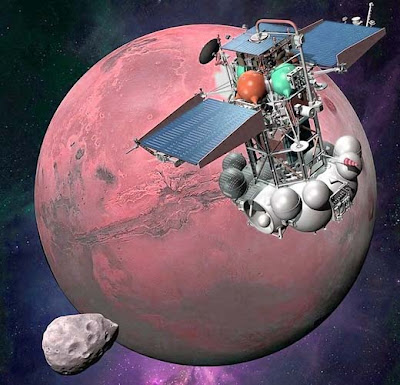
Russian officials acknowledge that the narrow ballistic window for the spacecraft to reach Mars has closed, making it another in a series of failures for the country's space research. Since the retirement of the last space shuttle in July, U.S. astronauts heading to the International Space Station need to hitch a ride with the Russians, but officials say Russia's space program is suffering from worn-out equipment, a graying workforce and inability to attract a new generation of young specialists The $167-million probe, launched Nov. 9, was intended as a major step back into exploration of the deeper cosmos by Russia's proud space program. It was to land on the Martian moon Phobos next year, pick up samples of dust and deliver them back to Earth.

After the probe separated from its main booster rocket, however, its engines failed to fire properly to set it on a path toward Mars, and it didn't respond to signals from ground control.

Source: http://www.latimes.com

Sunday, November 27, 2011

NASA Launches Super-Size Mars Rover to Red Planet

rover
The world's biggest extraterrestrial explorer, NASA's Curiosity rover, rocketed toward Mars on Saturday on a search for evidence that the red planet might once have been home to itsy-bitsy life It will take 8 1/2 months for Curiosity to reach Mars following a journey of 354 million miles.

An unmanned Atlas V rocket hoisted the rover, officially known as Mars Science Laboratory, into a cloudy late morning sky. A Mars frenzy gripped the launch site, with more than 13,000 guests jamming the space center for NASA's first launch to Earth's next-door neighbor in four years, and the first send-off of a Martian rover in eight years NASA astrobiologist Pan Conrad, whose carbon compound-seeking instrument is on the rover, had a shirt custom made for the occasion. Her bright blue, short-sleeve blouse was emblazoned with rockets, planets and the words, "Next stop Mars!"

The 1-ton Curiosity -- as large as a car -- is a mobile, nuclear-powered laboratory holding 10 science instruments that will sample Martian soil and rocks, and analyze them right on the spot There's a drill as well as a stone-zapping laser machine It's "really a rover on steroids," said NASA's Colleen Hartman, assistant associate administrator for science. "It's an order of magnitude more capable than anything we have ever launched to any planet in the solar system." The primary goal of the $2.5 billion mission is to see whether cold, dry, barren Mars might have been hospitable for microbial life once upon a time -- or might even still be conducive to life now.

Source: http://www.foxnews.com/

Monday, July 25, 2011

Next Mars Rover Targets Gale Crater

Mars
When NASA's Vikings reached Mars 35 years ago, scientists and engineers had only vague ideas about where the mission's twin life-seeking landers should set down on the surface. Remarkable in hindsight, members of the site-selection team gave themselves only two weeks to find the best landing spot for Viking 1 — and ultimately had to scrap their provisional Plans A and B (too many big rocks!) and delay the first landing by two more weeks as they scrambled to find a suitable Plan C.

There'll be no such hurry-up offense for the space agency's next Red Planet adventure. When the Mars Science Laboratory (a.k.a. "Curiosity") departs Earth on or about November 25th, the mission's 263 scientists will know with certainty that it's headed for 4.4868ºS and 137.4239ºE — a target on the broad floor of Gale crater.

NASA managers announced the choice of Gale over three other final candidates during an hour-long press briefing on Friday.

Whereas the Viking team had only relatively crude orbital imagery, some water-vapor measurements, and a few ground-based radar scans to work with, MSL's site selection involved deliberations over five years by 150 scientists, who hashed over 60 possible sites using 16 sets of detailed measurements and met in five dedicated workshops. The final four candidates, which underwent intense scrutiny after being picked in 2008, were:

Read More

Monday, July 18, 2011

Mars rover's destination decided

Mars Rover
After years of deliberation, NASA says it will announce the destination for its next Mars rover on Friday at the Smithsonian Institution's National Air and Space Museum.

Earlier this month, the choice was whittled down to two: NASA said the Curiosity rover, also known as the Mars Science Laboratory, would be launched either to Eberswalde Crater or Gale Crater. Today's announcement signals that a decision has been made.

Curiosity is already at NASA's Kennedy Space Center, undergoing final preparations for launch as early as Nov. 25, the day after Thanksgiving. The car-sized rover is scheduled to arrive at Mars in August 2012 to begin a primary scientific mission scheduled to last at least one Martian year, or roughly two Earth years.

Among the questions the $2.5 billion mission could answer: Were there areas on the Red Planet that could have been favorable for supporting microbial life? Could "molecular fossils" preserve the evidence of such life? Past missions have turned up evidence that ancient Mars was warmer and wetter than it is today, but how long did those life-friendly conditions last?

Read More

Tuesday, July 05, 2011

NASA Introduces Mars Rover "Curiosity," Debates Its Martian Landing Site

Mars Rover
Curiosity is expected to launch from Cape Canaveral Air Force Station in Florida on November 25, 2011, and will land on Mars in August 2012. The decision regarding its landing site is expected to be made this month

After recently retiring Mars rover Spirit, NASA is introducing a new Mars probe called Curiosity. While the rover is expected to launch later this year, one critical question remains unanswered: where will it land?

NASA rover Curiosity is a $2.5 billion, nuclear-powered machine that is the size of a Mini Cooper, and is four times as heavy as Spirit and Opportunity. Curiosity contains a laser that can vaporize rocks at seven meters, a percussive drill, a large robot arm and a weather station. In addition, it has 4.8kg of plutonium-238.

Curiosity's main mission on Mars is to find organic compounds as a "telltale sign" that life have existed on Mars. The problem is that scientist's must decide on a landing area that will most likely contain such evidence.

So far, scientist's have narrowed the choices down to four options: Eberswalde Crater, Mawrth Vallis, Gale Crater and Holden Crater

Read More

Thursday, June 09, 2011

Is NASA's $2.5 billion Mars rover doomed?

Mars Rover
NASA's next Mars rover, a nuclear-powered marvel nicknamed Curiosity, is supposed to blast off for the Red Planet later this year. But an audit issued this week by the space agency's inspector general finds a host of unresolved issues that could put the mission in jeopardy. Here, a brief guide to the mess:

What makes this rover so special?
It's "the most ambitious Mars project NASA has ever mounted," says Michelle Norris at NPR. Officially, the rover is called Mars Science Laboratory (MSL), but it's more commonly known as Curiosity

A nuclear-powered, car-sized vehicle, Curiosity is "the product of almost 10 years of work by 1,000 people," says Eryn Brown in the Los Angeles Times. Weighing four times as much as previous models (Spirit and Opportunity), it can drive long distances over rough terrain, and uses an unprecedented array of instruments to hunt for Martian life, says Lisa Grossman at Wired.

Read More

Wednesday, June 08, 2011

Mars Science Lab Needs $44 Million More For It to Launch This Year, NASA Says

mars rover
NASA’s newest Mars rover faces further hurdles and could require another $44 million in funds before it is ready for launch this fall, according to an agency audit announced today.

The Mars Science Laboratory is supposed to launch in a window between Thanksgiving and Christmas, when the alignment between Earth and Mars is the most favorable for an interplanetary trip. But as it stands now, the MSL team won’t finish all their work before launch unless they get more money, according to an internal audit prepared by NASA Inspector General Paul Martin.

“The project may have insufficient funds to complete all currently identified tasks prior to launch and may therefore be forced to reduce capabilities, delay the launch for 2 years, or cancel the mission,” he wrote.

Read More

Monday, June 06, 2011

For Mars rovers, a friendly rivalry

Mars Rover
NASA's newest Mars rover, Curiosity, will be deployed to the planet to study rocks that may shed light on whether life existed there. But its cousin Opportunity, which is already there, may steal its thunder.

NASA's newest Mars rover — or a replica of it, anyway — sat expectantly at the bottom of a hill. After years in design and construction, the grandly named Mars Science Laboratory was ready to test its wheels on a 20-degree flagstone slope in the "Mars Yard" at the Jet Propulsion Laboratory in La Cañada Flintridge.

Engineers crowded around to see whether the rover's aluminum wheels and titanium suspension were ready for Martian terrain, which varies from bedrock to rocky soil to soft sand. The first wheel slowly pivoted into position. Then another. Then a third, fourth, fifth and sixth — all making a crinkly sound as they slid through the soil. Once in position, the craft crept up the flagstone slope at about 8 feet per minute.

Read More

Wednesday, June 01, 2011

Mars Rover is dead but not gone

Mars Rover
NASA will no longer be sending commands to the Spirit rover on Mars, which has been sending satellite signals back to Earth since Jan. 2004. Prior to its loss of consciousness, Spirit’s mission was to search for signs of past water activity on Mars, according to SPACE.

Spirit found a great deal of evidence, which indicated that Mars was once a much wetter, warmer place, according to SPACE. However due to extreme cold temperatures, the cause of the robot’s fatality is most likely due to hypothermia, which has caused damaged to the rover’s electronics.

According to SPACE after Spirit lost power during the Martian winter in 2009-2010, the robot went into hibernation.

Read More

Friday, April 15, 2011

Students to Design Rovers with NASA

rover
The National Aeronautics and Space Administration (NASA) announced the selection of 80 students from 28 community colleges across the United States and Puerto Rico to participate in the National Community College Aerospace Scholars program. In a press release from NASA on April 7, 2011, the agency unveiled details about the program which is intended to encourage students to pursue careers in the STEM (Science, Technology, Engineering and Mathematics) disciplines.

The students were selected based on participation and completed assignments in an on-line program which was conducted during the school year. The chosen students will participate in the program at the Jet Propulsion Laboratory in Pasadena, California on April 27-29 or at the Johnson Space Center in Houston, Texas on May 12-14 this year.

The students will be separated into teams as hypothetical companies pursuing the exploration of Mars. The students will experience many of the challenges and use methods employed by actual scientists and engineers of the agency. The students will also be responsible for developing the company infrastructure as well as designing and creating a prototype rover for use on the planet

Read More

Thursday, April 07, 2011

How NASA will land a rover on Mars


NASA has produced an animated video explaining how it will send the 'Curiosity' rover to Mars. The five-minute clip shows a NASA spacecraft falling through the atmosphere of the Red Planet, and a floating crane depositing the 3-meter rover onto Mars' rocky surface. (See it for yourself below.) The video is meant to reflect the "dynamic, violent nature of landing on another planet," says Doug Ellison, a member of the animation team. Curiosity is expected to touch down on Mars in August 2012. It will take samples and atmospheric readings from the Martian soil, and attempt to answer the question: Is there life on Mars?

Thursday, March 31, 2011

MESSENGER Images from Orbit of Mercury-NASA Information


MESSENGER has delivered its first image since entering orbit about Mercury on March 17. It was taken today at 5:20 am EDT by the Mercury Dual Imaging System as the spacecraft sailed high above Mercury’s south pole, and provides a glimpse of portions of Mercury's surface not previously seen by spacecraft. The image was acquired as part of the orbital commissioning phase of the MESSENGER mission. Continuous global mapping of Mercury will begin on April 4.

“The entire MESSENGER team is thrilled that spacecraft and instrument checkout has been proceeding according to plan,” says MESSENGER Principal Investigator Sean Solomon, of the Carnegie Institution of Washington. “The first images from orbit and the first measurements from MESSENGER’s other payload instruments are only the opening trickle of the flood of new information that we can expect over the coming year. The orbital exploration of the Solar System’s innermost planet has begun.”

Wednesday, March 30, 2011

NASA's Mars Rover Goes Silent After Getting Stuck in Sand Trap

rover
One of NASA's Mars Rovers is no longer responding, and NASA is thinking about calling it quits and leaving it in the sandy bed.

NASA said it will make one last effort before ditching all efforts to “wake-up” the Mars Rover “Spirit.” Spirit fell silent nearly a year ago, and NASA engineers believe something is seriously wrong with Spirit— something more than just a power issue.

Spirit, a solar-powered Rover, sunk into a sand trap in 2009 during a routine drive. NASA attempted to wiggle it free, but Spirit remained stuck. And since it was unable to tilt itself toward the sun, the Rover went into hibernation.

NASA engineers had expected the rover to “wake up” once there was maximum sunlight filtrating the location where it's trapped, but that moment came and went earlier in March, and Spirit remained silent.

Read More

Tuesday, March 29, 2011

NASA scraps plan for 3D camera on Mars Rover

MARS
NASA has given up on the hope to build a 3D camera for the next robotic rover that the space agency will send to Mars.

Time simply ran out on efforts to develop the system and get it sufficiently tested before the Mars Science Laboratory rover, which has been dubbed Curiosity, is scheduled to launch later this year.

Movie director James Cameron, of Avatar and Titanic fame, has been helping to build the new camera, which would have both zoom and 3D capabilities.

Cameron has been working with Malin Space Science Systems of San Diego to build what would have been a 3D upgrade to the camera, dubbed Mastcam, already installed on Curiosity.

"With the Mastcam that was installed last year and the rover's other instruments, Curiosity can accomplish its ambitious research goals," Mars Science Laboratory Project Scientist John Grotzinger said in a written statement.

"The possibility for an upgrade was very much worth pursuing, but time became too short for the levels of testing that would be needed for them to confidently replace the existing cameras," Grotzinger.

Read More