Monday, February 14, 2011

Jupiter’s Moon Helps Peek Below Planet’s Belt


Astronomers have a new view of the chaos brewing beneath Jupiter’s cloud belt, thanks to some help from its icy moon Europa.

This new image, captured Nov. 30, 2010 with the 10-meter Keck II telescope in Hawaii, shows heat escaping from Jupiter’s interior, giving astronomers a peek into the roiling turmoil inside Jupiter’s missing red stripe.

The image shows Jupiter at four wavelengths of infrared light, which is beyond the range that human eyes can see. Three of those wavelengths show reflected sunlight. But one wavelength, 5 micrometers, can sense breaks in the cloud cover.

Jupiter’s famous red stripe mysteriously faded in late 2009 and vanished altogether by May, 2010. Observations with Hubble and other telescopes showed that the ruddy band was hiding beneath a layer of high, bright clouds made from icy ammonia crystals.

Thursday, February 10, 2011

Total lunar eclipse is coming


Total lunar eclipse is coming at 4:40pm this evening in Japan. If you are in the northern part of Japan, you have the higher chance to catch the lunar eclipse If clear sky, the total eclipse can be seen throughout Japan as the moon rises from east sky.
The last time that Japan had lunar eclipse was 3 years 4 months ago. This is once-in-a-while experience if you are lucky.
According to the report from WeatherNews Japan, because of unstable weather condition on the west side of Japan, the Norhern Japan has better chance to witness the total lunar eclipse.
The characteristics of lunar eclipse are that the moon turns to red.

Wednesday, February 09, 2011

Interior of Subsurface Cave Imaged on the Moon


The sun angle, camera angle and lighting conditions were just right for the Lunar Reconnaissance Orbiter camera to look all the way down to the floor of the pit. And this is no small hole in the ground — the LRO team says this pit is about 65 meters in diameter! This latest image confirms this object is actually a subsurface cave; a lava tube close to the surface where part of it has collapsed. These lava tubes could be great locations for lunar bases that could protect human explorers from dangers such as cosmic rays, meteorite impacts, and the extreme temperature differences between the lunar day and night.

This is the fourth time that this particular lunar pit has been imaged. Since LRO is constantly orbiting the Moon and it completes a full cycle of lunar imaging each month, the team can do follow up observations of previous discoveries and re-image targets under different lighting conditions.
Previous images had revealed the dark, cave-like entrance, and another showed part of the pit wall.
For this fourth imaging run, the spacecraft slewed 43° to the east and the solar incidence angle was 34° from vertical. This was just the right angle so that if there actually was an open lava tube extending horizontally its floor would be illuminated.
With LRO’s Narrow Angle Camera, the team was able to image a few meters under the overhang to show the interior of this sublunarean void. With this oblique angle, they were also able to capture the layered nature of the mare bedrock in the pit walls. These exposed layers give scientists important clues as to how the vast mare were deposited.
The collection of images now verifies this is actually a cavernous subsurface cave. These pits had been predicted to exist, based on the understanding of the geomorphology of mare deposits and lava flow behavior on Earth, but never directly imaged before.


Tuesday, February 08, 2011

Color Panorama of 'Santa Maria' Crater for Opportunity's Anniversary


NASA's Mars Exploration Rover Opportunity is spending the seventh anniversary of its landing on Mars investigating a crater called "Santa Maria," which has a diameter about the length of a football field.

This scene looks eastward across the crater. Portions of the rim of a much larger crater, Endurance, appear on the horizon. The panorama spans 125 compass degrees, from north-northwest on the left to south-southwest on the right. It has been assembled from multiple frames taken by the panoramic camera (Pancam) on Opportunity during the 2,453rd and 2,454th Martian days, or sols, of the rover's work on Mars (Dec. 18 and 19, 2010).

Opportunity landed in the Meridiani Planum region of Mars on Jan. 24, 2004, Universal Time (Jan. 25, Pacific Time) for a mission originally planned to last for three months. Since that prime mission, the rover has continued to work in bonus-time extended missions. Both Opportunity and its twin, Spirit, have made important discoveries about wet environments on ancient Mars that may have been favorable for supporting microbial life.

By mid-January 2011, Opportunity reached a location at the southeastern edge of Santa Maria crater. The rover team developed plans for Opportunity to spend a few weeks investigating rocks at that site during solar conjunction, a period when communications between Earth and Mars are curtailed because the sun is almost directly between the two planets.

After completion of its work at Santa Maria, the rover will resume a long-term trek toward Endeavour.

This view combines images taken through three different Pancam filters admitting light with wavelengths centered at 753 nanometers (near infrared), 535 nanometers (green) and 432 nanometers (violet). This "natural color" is the rover team's best estimate of what the scene would look like if we were there and able to see it with our own eyes. Seams have been eliminated from the sky portion of the mosaic to better simulate the vista a person standing on Mars would see.

LRO Could Have Given Apollo 14 Crew Another Majestic View


Although the Apollo 14 mission to the moon was filled with incredible sights and was completely successful it met all its science goals the crew experienced a bit of a disappointment at missing the spectacular view from the rim of a 1,000-foot-wide crater. They might have gazed into its depths if they had the high-resolution maps now available from NASA's Lunar Reconnaissance Orbiter (LRO) spacecraft.

Pressure was on the Apollo 14 mission, launched January 31, 1971, from the start. The Apollo 13 landing had to be aborted because an oxygen tank explosion crippled the spacecraft as it was on its way to the moon. It was a heroic effort just to return the crew safely to Earth, but the Apollo 14 team knew a second failure would probably result in cancellation of the remaining Apollo missions.

Friday, February 04, 2011

Seasonal Changes in Northern Mars Dune Field


Three images of the same location taken at different times on Mars show seasonal activity causing sand avalanches and ripple changes on a Martian dune. Time sequence of the images progresses from top to bottom. Each image covers an area 285 meters (312 yards) by 140 meters (153 yards). The crest of a dune curves across the upper and left portions of the image.

The High Resolution Imaging Science Experiment (HiRISE) camera on NASA's Mars Reconnaissance Orbiter took these images. The site is at 84 degrees north latitude, 233 degrees east longitude, in a vast region of dunes at the edge of Mars' north polar ice cap. The area is covered by carbon-dioxide ice in winter but is ice-free in summer. The top and bottom images show part of one dune about one Mars year apart, at a time of year when all the seasonal ice has disappeared: in late spring of one year (top) and early summer of the following year (bottom). The middle image is from the second year's mid-spring, when the region was still covered by seasonal carbon-dioxide ice.

Spring evaporation of the seasonal layer of ice is manifested as dark streaks of fine particles carried to the top of the ice layer by escaping gas. The bottom of the ice layer, in contact with the dark ground, warms faster than the top of the ice does in the spring. Carbon-dioxide gas produced by the thawing of the bottom ice is temporarily trapped under the top ice. As the ice evaporates from the bottom, flow of gas under the ice destabilizes the sand on the dune and causes the sand to avalanche down the dune slipface. A before-and-after comparison of the dune shows new alcoves and extension of the debris apron on the slipface of the dune caused by descending grains of sand. New wind ripples appear on the debris apron.

Thursday, February 03, 2011

Challenger Astronauts Memorialized on the Moon


Apollo is a 524 km-diameter impact basin located within the center of the the giant South Pole-Aitken basin. Apollo is also a Constellation Project Region of Interest, identified by NASA as a notional area for future human lunar exploration. The Constellation Region of Interest is located in the southwest corner of the mare deposit that fills this basin-within-a-basin. After the loss of the Space Shuttle Challenger, seven craters on the eastern rim of this basin were named after the crew: Gregory Jarvis, Christa McAuliffe, Ronald McNair, Ellison Onizuka, Judith Resnik, Dick Scobee, Michael Smith. Go to the WAC mosaic of the entire Apollo basin and surroundings.
NASA has learned hard lessons from each of our tragedies, and they are lessons that we will continue to keep at the forefront of our work as we continuously strive for a culture of safety that will help us avoid our past mistakes and heed warnings while corrective measures are possible. In memory of our colleagues, I ask the NASA Family once again to always make its opinions known and to be unafraid to speak up to those in authority, so that safety can always be our guiding principle and the sacrifices of our friends and colleagues will not be in vain.

On this Day of Remembrance, as we honor our fallen heroes with tributes and public ceremonies, I will take part in a wreath-laying ceremony at Arlington National Cemetery. Across the country, flags at NASA Headquarters and the NASA centers will be flown at half-mast in memory of our colleagues lost in the cause of exploration.

Tuesday, February 01, 2011

Cassini Provides Stunning New Looks at Several Moons


The Cassini spacecraft recently had a mini ‘grand tour’ of several of Saturn’s moons and just sent back some great images of Helene, Mimas, Enceladus and Dione. Above is an amazing view of the Trojan moon Helene, which is only 32 kilometers (20 miles across) and shares an orbit with Dione. Cassini came withing 28,000 km (17,398 miles) of Helene. Thanks to Stu Atkinson for an enhanced version of this raw Cassini image.
Cassini captured several images of the plumes spewing from Enceladus, and other closeup views of the moon’s terrain.
No images available yet from Cassini’s extremely close flyby of Titan over the weekend where it buzzed the hazy moon at an altitude of just 880 kilometers (547 miles) above the surface.
That is 70 kilometers (43 miles) lower than it has ever been at Titan before. The reason for attempting such a close pass is to try and establish if Titan has a magnetic field of its own. But the Cassini team went through hours and hours of calculations for this close flyby, as Titan’s atmosphere applies torque to objects flying through it, much the same way the flow of air would wiggle your hand around if you stuck it outside a moving car window.

Monday, January 31, 2011

Phobos, Mars' Large and Incredibly Close Moon


Phobos, the larger of Mars' two moons, is a fascinating place. The moon, discovered back in 1877, is small -- only about 17 miles long -- and orbits incredibly close to the surface of its host planet. Phobos, in fact, is so close to Mars that it moves around the planet faster than the planet itself rotates. If you were standing on the surface of Mars, you would see Phobos rise in the west and move across the sky in only a little more than four hours before disappearing to the east. And it's speeding up. As the orbital radius decreases, Phobos moves closer to the planet's surface and will one day either smash into Mars or break up into a planetary ring.
"[Its] origins are still something of a mystery, and the surface featured on Phobos are not totally understood either," Phil Plait wrote at Discover last week after these new photographs were taken. "Specifically, all those parallel grooves are pretty weird! The current thinking is that they were actually caused by impacts on Mars! It works like this: some giant rock hits Mars and blasts vast quantities of material up and out, some of which reaches up into space. Phobos plows into this material, and the direct impacts with big chunks can form craters."
These new images were taken by the High Resolution Stereo Camera (HRSC) aboard the European Space Agency's Mars Express probe after it passed within 66 miles of Mars' surface.

Friday, January 28, 2011

Saturnian moon's ocean full of gas


New data from NASA's Cassini spacecraft indicates the Saturnian moon Enceladus may have a fizzy ocean capable of harbouring life.
The findings could explain the vast icy plumes of water that spray into space through fissures - known as tiger stripes - on the moon's frozen surface.
Lead Cassini planetary scientist Dr Dennis Matson from NASA's Jet Propulsion Laboratory in Pasadena California, says "geophysicists expected Enceladus to be a lump of ice, cold, dead and uninteresting".
Instead scientists have recently discovered the moon is covered with geysers shooting plumes of water vapour, icy particles and organic compounds.
Matson says many researchers viewed the icy jets as proof of a large subterranean body of water.
Pockets of liquid water with temperatures around 0°C near the surface could explain the watery plumes.
Cassini's instruments detected have carbon, hydrogen, oxygen, nitrogen, and various hydrocarbons in the plumes gas.
In 2009, the spacecraft's cosmic dust analyser found sodium and potassium salts together with carbonates locked in the plumes' icy particles, strengthening the underground ocean hypothesis.

Wednesday, January 26, 2011

Chinese Mars 500 volunteer to be on 'Mars' for Spring Festival


Wang Yue, Chinese volunteer for the Mars 500 simulation of a manned spaceflight, will step out of the cabin of the experiment's "spaceship" and walk on a simulation of the Martian surface just in time for Chinese New Year, according to the website of China Manned Space Engineering.

The experimental cabin will land on the Mars on Feb. 1. At the end of Jan. 23, the Mars 500 experiment, which simulates a round-trip voyage to the red planet, had completed its 234th day.

As planned, the crew members will participate in a 30-day simulated landing on the surface of Mars.

It is reported that the Chinese participant, Wang Yue, has displayed a strong sense of teamwork and perseverance while conducting his research.

Li Yinghui, the Chinese team's deputy chief designer under the Mars-500 project, said considering the current carrying capacity, the Mars 500 project is a three-stage experiment, including a 250-day virtual flight to Mars, a 30-day stay on the planet and a 240-day journey back to earth

Monday, January 24, 2011

High tides mean it must be a full moon


High tides at the weekend left their mark on the South Canterbury coast.
On Brown's Beach, east of Temuka, driftwood and other debris were carried to the top of the beach at high tide early on Saturday morning, with some deposited on the stopbank separating the beach from farm paddocks beyond it.
The debris left a pool between the high point of the beach and the stopbank.
Environment Canterbury's duty flood controller, Graham Sullivan, said the tides over the past few days were higher than normal because it was a spring or perigean tide, which meant it coincided with the full moon.
He said the tide was below swell warning level and usually lasted about four days, with today being the last day.
The MetService website showed yesterday's high tide was 2.5 metres at 6.37am, followed by 2.4m at 7.02pm.
Today's high tides are expected to be at 7.32am and 8.01pm – 2.5m and 2.4m respectively.
From tomorrow tides should begin to ease, but are expected to rise to 2.5m again on February 18, which will be a full moon, and peak at 2.6m in the two days that follow.

Friday, January 21, 2011

Multiple Asteroid Strikes May Have Killed Mars’s Magnetic Field


Once upon a time, Mars had a magnetic field, just like Earth. Four billion years ago, it vanished, taking with it the planet’s chances of evolving life as we know it. Now scientists have proposed a new explanation for its disappearance.
A model of asteroids striking the red planet suggests that, while no single impact would have short-circuited the dynamo that powered its magnetism, a quick succession of 20 asteroid strikes could have done the job.
“Each one crippled a little bit,” said geophysicist Jafar Arkani-Hamed of the University of Toronto, author of the new study. “We believe those were enough to cripple, cripple, cripple, cripple until it killed all of the dynamo forever.”
Rocky planets like Earth, Mars, Mercury and even the moon get their magnetic fields from the movement of molten iron inside their cores, a process called convection. Packets of molten iron rise, cool and sink within the core, and generate an electric current. The planet’s spinning turns that current into a magnetic field in a system known as a dynamo.
Magnetic fields can shield a planet from the constant rain of high-energy particles carried in the solar wind by deflecting charged particles away from the surface. Some studies have suggested that Earth’s magnetic field could have protected early life forms from the sun’s most harmful radiation, allowing more complex life to develop. But traces of magnetism in the Martian surface reveal that the red planet lost its magnetic field some four billion years ago, leaving its atmosphere to be dessicated by the harsh solar wind.

Thursday, January 20, 2011

Lunar Mining Sparks Race to the Moon


Lunar geologists and space entrepreneurs are becoming increasingly intrigued by the concept of lunar mining now that researchers have discovered an abundance of water on the moon. But others are suggesting that many obstacles need to be overcome before such a project can be executed.
The discovery of lunar water has raised questions as to whether other resources such as helium 2 and rare Earth elements could be found on the moon as well. Now, certain countries are looking to race to the moon.
Paul Spudis, Ph.D., a lunar geologist and Senior Staff Scientist at the Lunar and Planetary Institute in Houston, Texas, has expressed interest in lunar mining and has even devised a plan for returning to the moon despite the fact that the Obama administration has no plans to return to the moon at all due to its cancellation of the Constellation program. Spudis' plan involves "robotic resource extraction and the deployment of space-based fuel depots" using water from the moon before any humans return to its surface.
On the other hand, Mike Wall, editor of SPACE.com, believes lunar mining should not be attempted before ironing out a few technical and legal issues. For instance, an international agreement consisting of property rights, a salvage law and a mining law would be needed in order to decide who owns the resources once they are extracted. The Outer Space Treaty does not allow nation states to claim territories on the moon, but it does not mention anything regarding resource mining, and laws need to be set before any mining on the moon begins.

Wednesday, January 19, 2011

Phoenix Mars Mission: Onto The Ice


Join Principal Investigator Peter H. Smith and the Phoenix Lander Team in Phoenix Mars Mission: Onto the Ice, a behind-the-scenes look at the first successful landing on the Mars polar region and the beginning of a new era in the search for signs of life on our neighboring planets.
A continuation of the enthralling story of last year's attempted NASA Mars exploration, Phoenix Mars Mission: Onto the Ice documents the difficult journey towards a successful Mars landing, behind the scenes and through the eyes of the people responsible for the mission’s success.
Phoenix Mars Mission: Onto the Ice follows the Phoenix Mars Lander's 422-million mile journey through space. The final destination is a carefully selected landing site in the northern Martian plains. But before the Lander can begin touching, tasting and sniffing Martian soil in search for signs of life, it first must land on the planet safely. From practice landings with simulated devastating malfunctions, through the heart-pounding "seven minutes of terror," decent onto the Red Planet, Phoenix Mars Mission: Onto the Ice follows the international team of talented and dedicated scientists, engineers and researchers as they work to successfully land on Mars and search for signs of life.
The solar powered Phoenix Lander was initially scheduled for a 90 day run on the surface of Mars. The Phoenix team must make every day and every experiment count in the battle with the ever sinking sun. The teams must race to extract every bit of data before the Martian winter plunges temperatures to minus 100 degrees Celsius. And when the lander can no longer phone home and the end of the lander phase of the mission is declared, what will the Phoenix Mars Mission have discovered? And, once the Mars winter is over, will the team be able to resurrect the Mars lander yet again?


Tuesday, January 18, 2011

China to launch 1st Mars probe in 2013


Qi Faren, an academician of the Chinese Academy of Engineering and chief designer of Shenzhou spaceships, indicated on Jan. 16 that China is expected to launch the first Mars probe in 2013.

The probe, Yinghuo-1(YH-1), was due to blast off in October 2009 with Russia's "Phobos Explorer" from the Baikonur Cosmodrome in Kazakhstan, but the launch was postponed.

Qi Faren disclosed that China and Russia will launch the first Mars probe this year. By 2013, there will be a minimum distance between the Mars and the Earth, which will be a good time to launch the Mars probe. If this opportunity is missed, China will have to wait several years to launch another. Therefore, China will consider launching its first Mars probe independently.

Qi said that this is only a consideration of the aerospace industry and not the Chinese government's formal decision-making at present. However, China's space industry is fully capable of successfully launching the Mars probe.

China's space industry plans important developments in the coming years, which will culminate in the construction of a space station by 2020, Qi said.
  
He explained that China will build the space station to solve four stages of difficult problems in research and development. China successfully and independently put a man into space in the first stage.

In the second stage, China will launch Tiangong-1, an unmanned space module, in the first half of 2011 and the Shenzhou-8 spacecraft in the second half of the year to carry out the nation's first-ever space docking.

Monday, January 17, 2011

NASA Prods Hibernating Mars Rover


Contrary to its name, the Sprint Mars rover remains decidedly stuck, and after nine months of waiting incommunicado NASA is fighting to restart communication with the antisocial android before winter turns the Red Planet blue. If scientists cannot reestablish communication before the end of Martian spring—mid-March—the rover may not survive winter.
Spring is the time to revive the rover. "The amount of solar energy available for Spirit is still increasing every day for the next few months," explains John Callas, Mars Exploration Rover Project Manager. "As long as that's the case, we will do all we can to increase the chances of hearing from the rover again."
The extraterrestrial's troubles began when its wheels cracked through the planet's crusty surface and sunk in the sand below. Despite numerous efforts to dislodge the vehicle, scientists declared it stuck last January. Since last spring, the rover has rested in low-power hibernation to conserve energy.
Sprint needs enough solar energy to thaw itself through winter. While NASA engineers have tried to position the robot's solar array towards the sun, if debris blows onto the panels, it won't absorb enough energy to wake.
Sprint and its sibling Opportunity have roamed the surface of the Red Planet for the past five years, considerably exceeding their expected mission of three months. Despite Sprint's recent troubles, Opportunity has stayed true to its name: the rover to continues exploring and sending back data. Last winter NASA even upgraded its firmware, enabling the robot to stop and analyze rocks as it roves the Martian surface. Now if only we could get software updates for five-year old hardware back home.

Wednesday, January 12, 2011

Mars' Water - Too Salty To Support Life


"Liquid water is required by all species on Earth and we've assumed that water is the very least that would be necessary for life on Mars," says Nicholas J. Tosca, a postdoctoral researcher in Harvard's Department of Organismic and Evolutionary Biology. "However, to really assess Mars' habitability we need to consider the properties of its water. Not all of Earth's waters are able to support life, and the limits of terrestrial life are sharply defined by water's temperature, acidity, and salinity."

Together with co-authors Andrew H. Knoll and Scott M. McLennan, Tosca analyzed salt deposits in four-billion-year-old Martian rock explored by NASA's Mars Exploration Rover, Opportunity, and by orbiting spacecraft. It was the Mars Rover whose reports back to Earth stoked excitement over water on the ancient surface of the Red Planet.

The new analysis suggests that even billions of years ago, when there was unquestionably some water on Mars, its salinity commonly exceeded the levels in which terrestrial life can arise, survive, or thrive.

"Our sense has been that while Mars is a lousy environment for supporting life today, long ago it might have more closely resembled Earth," says Knoll, Fisher Professor of Natural Sciences and professor of Earth and planetary sciences at Harvard. "But this result suggests quite strongly that even as long as four billion years ago, the surface of Mars would have been challenging for life. No matter how far back we peer into Mars' history, we may never see a point at which the planet really looked like Earth."

Read More

Link directory

A Few Facts About Lunar Tides


The gravitational force of the moon is one ten-millionth that of earth, but when you combine other forces such as the earth's centrifugal force created by its spin, you get tides.

The sun's gravitational force on the earth is only 46 percent that of the moon. Making the moon the single most important factor for the creation of tides.

The sun's gravity also produces tides. But since the forces are smaller, as compared to the moon, the effects are greatly decreased.

Tides are not caused by the direct pull of the moon's gravity. The moon is pulling upwards on the water while the earth is pulling downward. Slight advantage to the moon and thus we have tides.

Whenever the Moon, Earth and Sun are aligned, the gravitational pull of the sun adds to that of the moon causing maximum tides.

Spring tides happen when the sun and moon are on the same side of the earth (New Moon) or when the sun and moon are on opposite sides of the earth (Full Moon).

When the Moon is at first quarter or last quarter phase (meaning that it is located at right angles to the Earth-Sun line), the Sun and Moon interfere with each other in producing tidal bulges and tides are generally weaker; these are called neap tides.

Spring tides and neap tide levels are about 20% higher or lower than average.
Offshore, in the deep ocean, the difference in tides is usually less than 1.6 feet

Read More:

Tuesday, January 11, 2011

Life On the Moon

Scientists are looking for life in space. So far, they haven't found any life beyond Earth itself. We seem to be getting closer to discovering life somewhere else in our own solar system
, with Mars, and some moons of Jupiter and Saturn being considered likely hiding spots for microbes.
Could there be life closer to our home planet? Probably not, but it's worth considering what could be lurking on the Moon.
We've discovered evidence that the polar regions of the Moon are the coldest natural places in the solar system. It's not the sort of environment that's friendly to life. Anything that tried to survive there would certainly freeze. But what could these conditions preserve? Could the Moon be a storehouse of chemicals and structures that have disappeared from other regions of the solar system?
Part of the reason why we explore space is not only to discover life, but to find the precursors to life. Outer space holds the records of what conditions were like when the Earth was young, and life could have been getting started on our planet.
If certain regions on the Moon have been frozen for eons, the Moon could be one of our most promising areas for biotic chemistry research.

Friday, January 07, 2011

NASA Research Team Reveals Moon Has Earth-Like Core

State-of-the-art seismological techniques applied to Apollo-era data suggest our moon has a core similar to Earth's.

Uncovering details about the lunar core is critical for developing accurate models of the moon's formation. The data sheds light on the evolution of a lunar dynamo -- a natural process by which our moon may have generated and maintained its own strong magnetic field.

The team's findings suggest the moon possesses a solid, iron-rich inner core with a radius of nearly 150 miles and a fluid, primarily liquid-iron outer core with a radius of roughly 205 miles. Where it differs from Earth is a partially molten boundary layer around the core estimated to have a radius of nearly 300 miles. The research indicates the core contains a small percentage of light elements such as sulfur, echoing new seismology research on Earth that suggests the presence of light elements -- such as sulfur and oxygen -- in a layer around our own core.

The researchers used extensive data gathered during the Apollo-era moon missions. The Apollo Passive Seismic Experiment consisted of four seismometers deployed between 1969 and 1972, which recorded continuous lunar seismic activity until late-1977.

Thursday, January 06, 2011

NASA Tests New Propulsion System For Robotic Lander Prototype

NASA's Robotic Lunar Lander Development Project at Marshall Space Flight Center in Huntsville, Ala., has completed a series of hot fire tests and taken delivery of a new propulsion system for integration into a more sophisticated free-flying autonomous robotic lander prototype. The project is partnered with the Johns Hopkins University Applied Physics Laboratory in Laurel, Md., to develop a new generation of small, smart, versatile robotic landers to achieve scientific and exploration goals on the surface of the moon and near-Earth asteroids.

The new robotic lander prototype will continue to mature the development of a robotic lander capability by bringing online an autonomous flying test lander that will be capable of flying up to sixty seconds, testing the guidance, navigation and control system by demonstrating a controlled landing in a simulated low gravity environment.

By the spring of 2011, the new prototype lander will begin flight tests at the U.S. Army's Redstone Arsenal Test Center in Huntsville, Ala.

The prototype’s new propulsion system consists of 12 small attitude control thrusters, three primary descent thrusters to control the vehicle’s altitude, and one large "gravity-canceling" thruster which offsets a portion of the prototype’s weight to simulate a lower gravity environment, like that of the moon and asteroids. The prototype uses a green propellant, hydrogen peroxide, in a stronger concentration of a solution commonly used in homes as a disinfectant. The by-products after use are water and oxygen.

Tuesday, January 04, 2011

Rover Will Spend 7th Birthday at Stadium-Size Crater


The High Resolution Imaging Science Experiment (HiRISE) camera on NASA's Mars Reconnaissance Orbiter captured a Dec. 31, 2010, view of the Mars Exploration Rover Opportunity on the southwestern rim of a football-field-size crater called "Santa Maria."

Opportunity arrived at the western edge of Santa Maria crater in mid-December and will spend about two months investigating rocks there. That investigation will take Opportunity into the beginning of its eighth year on Mars. Opportunity landed in the Meridiani Planum region of Mars on Jan. 25, 2004, Universal Time (Jan. 24, Pacific Time) for a mission originally planned to last for three months.


Wednesday, December 29, 2010

WISE Sees an Explosion of Infrared Light


NASA - A circular rainbow appears like a halo around an exploded star in this new view of the IC 443 nebula from NASA's Wide-field Infrared Survey Explorer, or WISE.

When massive stars die, they explode in tremendous blasts, called supernovae, which send out shock waves. The shock waves sweep up and heat surrounding gas and dust, creating supernova remnants like the one pictured here. The supernova in IC 443 happened somewhere between 5,000 and 10,000 years ago.

In this WISE image, infrared light has been color-coded to reveal what our eyes cannot see. The colors differ primarily because materials surrounding the supernova remnant vary in density. When the shock waves hit these materials, different gases were triggered to release a mix of infrared wavelengths.

The supernova remnant's northeastern shell, seen here as the violet-colored semi-circle at top left, is composed of sheet-like filaments that are emitting light from iron, neon, silicon and oxygen gas atoms and dust particles heated by a fast shock wave traveling at about 100 kilometers per second, or 223,700 mph.

The smaller southern shell, seen in bright bluish colors, is constructed of clumps and knots primarily emitting light from hydrogen gas and dust heated by a slower shock wave traveling at about 30 kilometers per second, or 67,100 miles per hour. In the case of the southern shell, the shock wave is interacting with a nearby dense cloud. This cloud can be seen in the image as the greenish dust cutting across IC 443 from the northwest to southeast.

Thursday, December 23, 2010

Dreaming of a Blue Sunset


A new Mars movie clip gives us a rover's-eye view of a bluish Martian sunset, while another clip shows the silhouette of the moon Phobos passing in front of the sun.

America's Mars Exploration Rover Opportunity, carefully guided by researchers with an artistic sense, has recorded images used in the simulated movies.

These holiday treats from the rover's panoramic camera, or Pancam, offer travel fans a view akin to standing on Mars and watching the sky.

"These visualizations of an alien sunset show what it must have looked like for Opportunity, in a way we rarely get to see, with motion," said rover science team member Mark Lemmon of Texas A&M University, College Station. Dust particles make the Martian sky appear reddish and create a bluish glow around the sun.

Lemmon worked with Pancam Lead Scientist Jim Bell, of Cornell University, Ithaca, N.Y., to plot the shots and make the moving-picture simulation from images taken several seconds apart in both sequences.

The sunset movie, combining exposures taken Nov. 4 and Nov. 5, 2010, through different camera filters, accelerates about 17 minutes of sunset into a 30-second simulation. One of the filters is specifically used to look at the sun. Two other filters used for these shots provide color information. The rover team has taken Pancam images of sunsets on several previous occasions, gaining scientifically valuable information about the variability of dust in the lower atmosphere. The new clip is the longest sunset movie from Mars ever produced, taking advantage of adequate solar energy currently available to Opportunity.

Wednesday, December 22, 2010

Apollo 8: Christmas at the Moon

Christmas Eve, 1968. As one of the most turbulent, tragic years in American history drew to a close, millions around the world were watching and listening as the Apollo 8 astronauts -- Frank Borman, Jim Lovell and Bill Anders -- became the first humans to orbit another world.

As their command module floated above the lunar surface, the astronauts beamed back images of the moon and Earth and took turns reading from the book of Genesis, closing with a wish for everyone "on the good Earth."


Monday, December 20, 2010

NASA's LRO Creating Unprecedented Topographic Map of Moon

NASA's Lunar Reconnaissance Orbiter is allowing researchers to create the most precise and complete map to date of the moon's complex, heavily cratered landscape.

"This dataset is being used to make digital elevation and terrain maps that will be a fundamental reference for future scientific and human exploration missions to the moon," said Dr. Gregory Neumann of NASA's Goddard Space Flight Center in Greenbelt, Md. "After about one year taking data, we already have nearly 3 billion data points from the Lunar Orbiter Laser Altimeter on board the LRO spacecraft, with near-uniform longitudinal coverage. We expect to continue to make measurements at this rate through the next two years of the science phase of the mission and beyond. Near the poles, we expect to provide near-GPS-like navigational capability as coverage is denser due to the spacecraft's polar orbit." Neumann will present the map at the American Geophysical Union meeting in San Francisco December 17.

Friday, December 17, 2010

NASA Spacecraft Provides Travel Tips for Mars Rover

NASA's Mars Opportunity rover is getting important tips from an orbiting spacecraft as it explores areas that might hold clues about past Martian environments.

Researchers are using a mineral-mapping instrument aboard NASA's Mars Reconnaissance Orbiter to help the rover investigate a large ancient crater called Endeavour. The orbiter's Compact Reconnaissance Imaging Spectrometer for Mars (CRISM) is providing maps of minerals at Endeavour's rim that are helping the team choose which area to explore first and where to go from there. As Mars Reconnaissance Orbiter orbits more than 241 kilometers high (150 miles), the CRISM instrument provides mapping information for mineral exposures on the surface as small as a tennis court.

"This is the first time mineral detections from orbit are being used in tactical decisions about where to drive on Mars," said Ray Arvidson of Washington University in St. Louis. Arvidson is the deputy principal investigator for the Spirit and Opportunity rovers and a co-investigator for CRISM.


Thursday, December 16, 2010

NASA's Odyssey Spacecraft Sets Exploration Record on Mars

NASA's Mars Odyssey, which launched in 2001, will break the record Wednesday for longest-serving spacecraft at the Red Planet. The probe begins its 3,340th day in Martian orbit at 5:55 p.m. PST (8:55 p.m. EST) on Wednesday to break the record set by NASA's Mars Global Surveyor, which orbited Mars from 1997 to 2006.

Odyssey's longevity enables continued science, including the monitoring of seasonal changes on Mars from year to year and the most detailed maps ever made of most of the planet. In 2002, the spacecraft detected hydrogen just below the surface throughout Mars' high-latitude regions. The deduction that the hydrogen is in frozen water prompted NASA's Phoenix Mars Lander mission, which confirmed the theory in 2008. Odyssey also carried the first experiment sent to Mars specifically to prepare for human missions, and found radiation levels around the planet from solar flares and cosmic rays are two to three times higher than around Earth.

Odyssey also has served as a communication relay, handling most of the data sent home by Phoenix and NASA's Mars Exploration Rovers Spirit and Opportunity. Odyssey became the middle link for continuous observation of Martian weather by NASA's Mars Global Surveyor and NASA's Mars Reconnaissance Orbiter.


Wednesday, December 15, 2010

Cassini Spots Potential Ice Volcano on Saturn Moon


NASA's Cassini spacecraft has found possible ice volcanoes on Saturn's moon Titan that are similar in shape to those on Earth that spew molten rock.

Topography and surface composition data have enabled scientists to make the best case yet in the outer solar system for an Earth-like volcano landform that erupts in ice. The results were presented today at the American Geophysical Union meeting in San Francisco.

"When we look at our new 3-D map of Sotra Facula on Titan, we are struck by its resemblance to volcanoes like Mt. Etna in Italy, Laki in Iceland and even some small volcanic cones and flows near my hometown of Flagstaff," said Randolph Kirk, who led the 3-D mapping work, and is a Cassini radar team member and geophysicist at the U.S. Geological Survey (USGS) Astrogeology Science Center in Flagstaff, Ariz.


Friday, December 10, 2010

Odyssey Orbiter Nears Martian Longevity Record


NASA's Mars Odyssey orbiter will have worked longer at Mars than any other spacecraft in history.

Odyssey entered orbit around Mars on Oct. 24, 2001. On Dec. 15, the 3,340th day since that arrival, it will pass the Martian career longevity record set by its predecessor, Mars Global Surveyor, which operated in orbit from Sept. 11, 1997, to Nov. 2, 2006.

Odyssey made its most famous discovery -- evidence for copious water ice just below the dry surface of Mars -- during its first few months, and it finished its radiation-safety check for future astronauts before the end of its prime mission in 2004. The bonus years of extended missions since then have enabled many accomplishments that would not have been possible otherwise.


Wednesday, December 08, 2010

NASA Mars Rover Images Honor Apollo 12

NASA's Mars Exploration Rover Opportunity has visited and photographed two craters informally named for the spacecraft that carried men to the moon 41 years ago this week.

Opportunity drove past "Yankee Clipper" crater on Nov. 4 and reached "Intrepid crater" on Nov. 9. For NASA's Apollo 12, the second mission to put humans onto the moon, the command and service module was called Yankee Clipper, piloted by Dick Gordon, and the lunar module was named Intrepid, piloted by Alan Bean and commanded by the late Pete Conrad. The Intrepid landed on the moon with Bean and Conrad on Nov. 19, 1969, while Yankee Clipper orbited overhead. Their landing came a mere four months after Apollo 11's first lunar landing.


Thursday, November 18, 2010

NASA's Mobile Mars Laboratory nearly complete for Flight

NASA's Mobile Mars Laboratory
The Sample Analysis at Mars (SAM) instrument suite has completed assembly at NASA's Goddard Space Flight Center in Greenbelt, Md., and is nearly ready for a December delivery to NASA's Jet Propulsion Laboratory (JPL), Pasadena, Calif., where it will be joined to the Curiosity rover. SAM and Curiosity are set to fly on the upcoming Mars Science Laboratory (MSL) rover mission scheduled for launch in the fall of 2011.

SAM will become an automated, mobile laboratory as it is carried across Mars by the rover when the mission arrives at the Red Planet in 2012. Together with other instruments on Curiosity, SAM will assess whether Mars ever was, or is still today, an environment able to support microbial life.

"We expect Curiosity will make amazing discoveries," said SAM Principal Investigator Dr. Paul Mahaffy of NASA Goddard, "and we are looking forward to the contributions our mobile chemistry laboratory can make to a better understanding of the history of our neighboring planet."

SAM is in flight configuration, meaning its instruments are in the condition they will be during launch and are ready to begin operations on Mars. The instrument suite (a mass spectrometer, gas chromatograph, and tunable laser spectrometer) has started final environmental testing this week, which includes vibration and thermal testing to ensure SAM can survive the launch, deep space flight, and conditions on Mars.

Once at Mars, SAM will examine the planet's habitability by exploring molecular and elemental chemistry relevant to life. SAM will analyze samples of Martian rock and soil to assess carbon chemistry through a search for organic compounds. The lab will also determine the chemical state of light elements other than carbon, and look for isotopic tracers of planetary change.

Wednesday, October 20, 2010

Pinwheel of Star Birth


NASA - Though the universe is chock full of spiral-shaped galaxies, no two look exactly the same. This face-on spiral galaxy, called NGC 3982, is striking for its rich tapestry of star birth, along with its winding arms. The arms are lined with pink star-forming regions of glowing hydrogen, newborn blue star clusters, and obscuring dust lanes that provide the raw material for future generations of stars. The bright nucleus is home to an older population of stars, which grow ever more densely packed toward the center.

NGC 3982 is located about 68 million light-years away in the constellation Ursa Major. The galaxy spans about 30,000 light-years, one-third of the size of our Milky Way galaxy. This color image is composed of exposures taken by the Hubble Space Telescope's Wide Field Planetary Camera 2 (WFPC2), the Advanced Camera for Surveys (ACS), and the Wide Field Camera 3 (WFC3). The observations were taken between March 2000 and August 2009. The rich color range comes from the fact that the galaxy was photographed invisible and near-infrared light. Also used was a filter that isolates hydrogen emission that emanates from bright star-forming regions dotting the spiral arms.

The Hubble Space Telescope is a project of international cooperation between NASA and the European Space Agency. NASA's Goddard Space Flight Center manages the telescope. The Space Telescope Science Institute (STScI) conducts Hubble science operations. STScI is operated for NASA by the Association of Universities for Research in Astronomy, Inc. in Washington, D.C.

Friday, October 08, 2010

MAVEN task to consider – “How Sun Steals Martian Atmosphere”

The Red Planet bleeds. Not blood, but its atmosphere, slowly trickling away to space. The culprit is our sun, which is using its own breath, the solar wind, and its radiation to rob Mars of its air. The crime may have condemned the planet's surface, once apparently promising for life, to a cold and sterile existence.

In the upper left of this Hubble Space Telescope image, at high northern latitudes, a large chevron-shaped area of water ice clouds mark a storm front. Along the right limb, a large cloud system has formed around the Olympus Mons volcano
Features on Mars resembling dry riverbeds, and the discovery of minerals that form in the presence of water, indicate that Mars once had a thicker atmosphere and was warm enough for liquid water to flow on the surface. However, somehow that thick atmosphere got lost in space. It appears Mars has been cold and dry for billions of years, with an atmosphere so thin, any liquid water on the surface quickly boils away while the sun's ultraviolet radiation scours the ground.

Such harsh conditions are the end of the road for known forms of life. Although it's possible that martian life went underground, where liquid water may still exist and radiation can't reach.

The lead suspect for the theft is the sun, and its favorite M.O. may be the solar wind. All planets in our solar system are constantly blasted by the solar wind, a thin stream of electrically charged gas that continuously blows from the sun's surface into space. On Earth, our planet's global magnetic field shields our atmosphere by diverting most of the solar wind around it. The solar wind’s electrically charged particles, ions and electrons, have difficulty crossing magnetic fields.

"Mars can't protect itself from the solar wind because it no longer has a shield, the planet's global magnetic field is dead," said Bruce Jakosky of the University of Colorado, Boulder. Jakosky is the Principal Investigator for NASA's MAVEN mission, which will investigate what is responsible for the loss of the martian atmosphere. NASA selected the MAVEN (Mars Atmosphere and Volatile Evolution Mission) on September 15, 2008.

Tuesday, October 05, 2010

Ping-Pong Balls to Float Crew Capsule Simulator

If ping-pong balls can float a sunken boat, they should be able to keep an uncrewed space capsule simulator from sinking.

That's what a team of summer students and engineers think at NASA’s Langley Research Center in Hampton, Va. Langley is fabricating a proposed design of an astronaut crew module simulator for uncrewed flight-testing as part of the agency's effort to build a vehicle to replace the space shuttle.

Because the crew module will not be pressurized during the test, it will not have the buoyancy of a pressurized spacecraft. This puts the simulated crew module at risk of sinking to the bottom of the Atlantic Ocean after splashdown.

Ping-Pong Ball
"At first we didn't really realize that we were going to get so far in proving that it would be possible," said Kirk, a Suffolk, Va., native attending Virginia Tech as an aerospace engineering major. "But when we thought about everything logically, it just seemed like ping-pong balls were the way to go."

She and a team of seven other students worked the project in Langley's Mechanical Systems Branch, where they were assigned for the summer.

DiNonno got the idea from a Discovery Channel program about raising a sunken boat using 27,000 ping-pong balls.

Engineer David Covington said that when DiNonno suggested the ping-pong ball idea, "I just laughed. Not a 'what are you thinking' kind of laugh, but more of a 'that's the most awesome thing I've heard in a long time' laugh. I asked him 'are you serious?' and he said 'yeah, we're authorized to do a four-week study.' So we went straight to work."

Wednesday, September 22, 2010

NASA's LRO Exposes Moon's Complex, Turbulent Youth

The moon was bombarded by two distinct populations of asteroids or comets in its youth, and its surface is more complex than previously thought, according to new results from NASA's Lunar Reconnaissance Orbiter (LRO) spacecraft featured in three papers appearing in the Sept. 17 issue of Science.

Moon
In the first paper, lead author James Head of Brown University in Providence, R.I., describes results obtained from a detailed global topographic map of the moon created using LRO's Lunar Orbiter Laser Altimeter (LOLA). "Our new LRO LOLA dataset shows that the older highland impactor population can be clearly distinguished from the younger population in the lunar 'maria' -- giant impact basins filled with solidified lava flows," says Head. "The highlands have a greater density of large craters compared to smaller ones, implying that the earlier population of impactors had a proportionally greater number of large fragments than the population that characterized later lunar history."

Meteorite impacts can radically alter the history of a planet. The moon, Mars, and Mercury all bear scars of ancient craters hundreds or even thousands of miles across. If Earth was subjected to this assault as well -- and there's no reason to assume our planet was spared -- these enormous impacts could have disrupted the initial origin of life. Large impacts that occurred later appear to have altered life's evolution. The approximately 110-mile-diameter, partially buried crater at Chicxulub, in the Yucatan Peninsula of Mexico, is from an impact about 65 million years ago that is now widely believed to have led or contributed to the demise of the dinosaurs and many other lifeforms.

Scientists trying to reconstruct the meteorite bombardment history of Earth face difficulty because impact craters are eroded by wind and water, or destroyed by the action of plate tectonics, the gradual movement and recycling of the Earth's crust. However, a rich record of craters is preserved on the moon, because it has only an extremely thin atmosphere – a vacuum better than those typically used for experiments in laboratories on Earth. The moon’s surface has no liquid water and no plate tectonics. The only source of significant erosion is other impacts.

"The moon is thus analogous to a Rosetta stone for understanding the bombardment history of the Earth," said Head. "Like the Rosetta stone, the lunar record can be used to translate the 'hieroglyphics' of the poorly preserved impact record on Earth."

Tuesday, September 07, 2010

The Moon Puts on Camo

A new geologic map of the moon's Schrödinger basin paints an instant, camouflage-colored portrait of what a mash-up the moon's surface is after eons of violent events. The geologic record at Schrödinger is still relatively fresh because the basin is only about 3.8 billion years old; this makes it the moon's second-youngest large basin (it's roughly 320 kilometers, or 200 miles, in diameter).


This detailed geologic map of Schrödinger basin, which formed when a huge object struck the moon, reveals a patchwork of lunar material, including the peak ring (inner brown ring), recent volcanic activity (red), cratering (yellow) and plains material (dark green and kelly green). Credit: NASA/Scott Mest

Schrödinger is located near the moon's south pole, a region where pockets of permanent ice are thought to exist. The map will help researchers understand lunar geologic history and identify suitable landing sites for future exploration. Scott Mest, a research scientist with the Planetary Science Institute working at NASA's Goddard Space Flight Center in Greenbelt, Md., and his colleagues created this geologic map -- the most detailed one to date -- by combining topographic data from the Lunar Orbiter Laser Altimeter, a Goddard instrument aboard the 2009 Lunar Reconnaissance Orbiter, with images and spectral data from the earlier Clementine and Lunar Prospector missions.

Schrödinger is an example of an intriguing type of basin called a peak-ring. Like the basin rim (brown outer ring), the smaller and more fragmented peak ring (brown inner ring) is a mountainous region of crust that rose up after a huge object, probably measuring 35-40 kilometers, or about 21-25 miles, smacked into the moon here. These areas of raised crust are the oldest rocks in the basin and just about the only material that wasn't melted by the heat from the object's impact. The melted material was spewed in all directions and formed the plains. Patches of plains material can have slightly different textures and albedo (indicated by dark green and kelly green), probably because they cooled at different times. Fractures (black lines) formed in the basin floor as the material cooled.

Friday, August 20, 2010

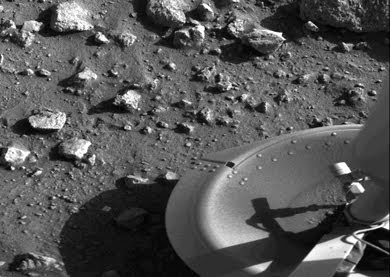
NASA's Marks 35th Anniversary of Mars Viking Mission

First photograph ever taken on the surface of the planet Mars
From the perennial Mars hoax to Ray Bradbury's The Martian Chronicles, no other body in our solar system has so captured the human imagination. Throughout history mankind has gazed into the night sky wondering what civilizations awaited those who landed on the Red Planet's surface. The novels of Burroughs and others tout the planet's allure and films have warned humanity of its dangers.

In 1965, the Mariner 4 spacecraft sent the first images of another planet to waiting scientists on Earth. Since that image, the Red Planet has revealed a world strangely familiar, yet challenging. Each time scientists feel close to understanding Mars, new discoveries send them back to the drawing board to revise existing theories.

In the 35 years since NASA launched Viking 1 on Aug. 20, 1975, the ambitious mission only whetted the scientific world and public's enthusiasm for future space exploration. In the ensuing years, NASA has launched the Phoenix Mars Lander, Mars Reconnaissance Orbiter and Mars Exploration Rovers, among others. Perhaps the most successful of these missions is Mars Exploration Rovers. Launched in June and July 2003, respectively, Spirit and Opportunity landed on Mars each for a 90-day mission that continues after more than 6 years.

For centuries, scientists wondered if Mars might be covered with vegetation -- or even inhabited by intelligent beings. Today, we know Mars to be quite different. It is a frozen desert world with now silent volcanoes and deep canyons. Polar ice caps expand and contract with the Martian seasons.

While the story began years earlier, it culminated in August and September 1975 with the launch of two large, nearly identical spacecraft from Cape Canaveral, Fl. Vikings 1 and 2, named for the fearless Nordic explorers of Earth, finally give humans a close-up look at this alien world.

Viking 1 and 2, each consisting of an orbiter and a lander, became the first space probes to obtain high resolution images of the Martian surface; characterize the structure and composition of the atmosphere and surface; and conduct on-the-spot biological tests for life on another planet.

Among the discoveries about Mars over the years, one stands out above all others: the possible presence of liquid water, either in its ancient past or preserved in the subsurface today. Water is key because almost everywhere water is found on Earth, so is life. If Mars once had liquid water, or still does today, it's compelling to ask whether any microscopic life forms could have developed on its surface.

Viking 1 arrived at Mars on June 19, 1976. On July 20, 1976, the Viking 1 lander separated from the orbiter and touched down at Chryse Planitia. Viking 2 was launched Sept. 9, 1975, and entered Mars orbit Aug. 7, 1976. The Viking 2 lander touched down at Utopia Planitia on Sept. 3, 1976.

Tuesday, August 10, 2010

Hundreds of New vision from Telescope ranging Mars


The latest set of new images from the telescopic High Resolution Imaging Science Experiment Camera on NASA's Mars Reconnaissance Orbiter offers detailed views of diverse Martian landscapes.

Features as small as desks are revealed in the 314 observations made between June 6 and July 7, 2010, now available on the camera team's site and NASA's Planetary Data System.

The camera is one of six instruments on NASA's Mars Reconnaissance Orbiter, which reached Mars in 2006. For more information about the mission, see http://mars.jpl.nasa.gov/mro/ .

Thursday, June 17, 2010

Research Suggests Water Content of Moon's Interior Underestimated

Earthrise as seen from Apollo 8.NASA - funded scientists estimate from recent research that the volume of water molecules locked inside minerals in the moon’s interior could exceed the amount of water in the Great Lakes here on Earth.

Scientists at the Carnegie Institution’s Geophysical Laboratory in Washington, along with other scientists across the nation, determined that the water was likely present very early in the moon’s formation history as hot magma started to cool and crystallize. This finding means water is native to the moon.

“For over 40 years we thought the moon was dry,” said Francis McCubbin of Carnegie and lead author of the report published in Monday's Online Early Edition of the Proceedings of the National Academy of Sciences. “In our study we looked at hydroxyl, a compound with an oxygen atom bound with hydrogen, and apatite, a water-bearing mineral in the assemblage of minerals we examined in two Apollo samples and a lunar meteorite.”

McCubbin’s team utilized tests which detect elements in the parts per billion range. Combining their measurements with models that characterize how the material crystallized as the moon cooled during formation, they found that the minimum water content ranged from 64 parts per billion to 5 parts per million. The result is at least two orders of magnitude greater than previous results from lunar samples that estimated water content of the moon to be less than 1 parts per billion.

"In this case, when we talk about water on the moon, we mean water in the structural form hydroxyl,” said Jim Green, director of the Planetary Science Division at NASA Headquarters in Washington. “This is a very minor component of the rocks that make up the lunar interior.”

The origin of the moon is now commonly believed to be the result of a Mars-sized object that impacted the Earth 4.5 billion years ago. This impact put a large amount of material into Earth’s orbit that ultimately compacted to form the moon. The lunar magma ocean that is thought to have formed at some point during the compacting process, began to cool. During this cooling, water either escaped or was preserved as hydroxyl molecules in the crystallizing minerals.

Tuesday, June 08, 2010

NASA Rover Finds Clue to Mars' Past And Environment for Life

Rocks examined by NASA's Spirit Mars Rover hold evidence of a wet, non-acidic ancient environment that may have been favorable for life. Confirming this mineral clue took four years of analysis by several scientists.

An outcrop that Spirit examined in late 2005 revealed high concentrations of carbonate, which originates in wet, near-neutral conditions, but dissolves in acid. The ancient water indicated by this find was not acidic.

NASA's rovers have found other evidence of formerly wet Martian environments. However the data for those environments indicate conditions that may have been acidic. In other cases, the conditions were definitely acidic, and therefore less favorable as habitats for life.

Laboratory tests helped confirm the carbonate identification. The findings were published online Thursday, June 3 by the journal Science.

"This is one of the most significant findings by the rovers," said Steve Squyres of Cornell University in Ithaca, N.Y. Squyres is principal investigator for the Mars twin rovers, Spirit and Opportunity, and a co-author of the new report. "A substantial carbonate deposit in a Mars outcrop tells us that conditions that could have been quite favorable for life were present at one time in that place. "


Spirit inspected rock outcrops, including one scientists called Comanche, along the rover's route from the top of Husband Hill to the vicinity of the Home Plate plateau which Spirit has studied since 2006. Magnesium iron carbonate makes up about one-fourth of the measured volume in Comanche. That is a tenfold higher concentration than any previously identified for carbonate in a Martian rock.

"We used detective work combining results from three spectrometers to lock this down," said Dick Morris, lead author of the report and a member of a rover science team at NASA's Johnson Space Center in Houston."The instruments gave us multiple, interlocking ways of confirming the magnesium iron carbonate, with a good handle on how much there is."

Massive carbonate deposits on Mars have been sought for years without much success. Numerous channels apparently carved by flows of liquid water on ancient Mars suggest the planet was formerly warmer, thanks to greenhouse warming from a thicker atmosphere than exists now. The ancient, dense Martian atmosphere was probably rich in carbon dioxide, because that gas makes up nearly all the modern, very thin atmosphere.

It is important to determine where most of the carbon dioxide went. Some theorize it departed to space. Others hypothesize that it left the atmosphere by the mixing of carbon dioxide with water under conditions that led to forming carbonate minerals. That possibility, plus finding small amounts of carbonate in meteorites that originated from Mars, led to expectations in the 1990s that carbonate would be abundant on Mars. However, mineral-mapping spectrometers on orbiters since then have found evidence of localized carbonate deposits in only one area, plus small amounts distributed globally in Martian dust.