Monday, March 04, 2013

Hubble Observes Glowing, Fiery Shells of Gas

Hubble Observes Glowing, Fiery Shells of Gas

It may look like something from "The Lord of the Rings," but this fiery swirl is actually a planetary nebula known as ESO 456-67. Set against a backdrop of bright stars, the rust-colored object lies in the constellation of Sagittarius (The Archer), in the southern sky.

Despite the name, these ethereal objects have nothing at all to do with planets; this misnomer came about over a century ago, when the first astronomers to observe them only had small, poor-quality telescopes. Through these, the nebulae looked small, compact, and planet-like - and so were labeled as such.

When a star like the sun approaches the end of its life, it flings material out into space. Planetary nebulae are the intricate, glowing shells of dust and gas pushed outwards from such a star. At their centers lie the remnants of the original stars themselves - small, dense white dwarf stars.

In this image of ESO 456-67, it is possible to see the various layers of material expelled by the central star. Each appears in a different hue - red, orange, yellow, and green-tinted bands of gas are visible, with clear patches of space at the heart of the nebula. It is not fully understood how planetary nebulae form such a wide variety of shapes and structures; some appear to be spherical, some elliptical, others shoot material in waves from their polar regions, some look like hourglasses or figures of eight, and others resemble large, messy stellar explosions - to name but a few.

Real estate tips Follow @davelindahltips

Wednesday, December 19, 2012

A Cosmic Holiday Ornament, Hubble-Style

'Tis the season for holiday decorating and tree-trimming. Not to be left out, astronomers using NASA's Hubble Space Telescope have photographed a festive-looking nearby planetary nebula called NGC 5189. The intricate structure of this bright gaseous nebula resembles a glass-blown holiday ornament with a glowing ribbon entwined.

Planetary nebulae represent the final brief stage in the life of a medium-sized star like our sun. While consuming the last of the fuel in its core, the dying star expels a large portion of its outer envelope. This material then becomes heated by the radiation from the stellar remnant and radiates, producing glowing clouds of gas that can show complex structures, as the ejection of mass from the star is uneven in both time and direction.

A spectacular example of this beautiful complexity is seen in the bluish lobes of NGC 5189. Most of the nebula is knotty and filamentary in its structure. As a result of the mass-loss process, the planetary nebula has been created with two nested structures, tilted with respect to each other, that expand away from the center in different directions.

This double bipolar or quadrupolar structure could be explained by the presence of a binary companion orbiting the central star and influencing the pattern of mass ejection during its nebula-producing death throes. The remnant of the central star, having lost much of its mass, now lives its final days as a white dwarf. However, there is no visual candidate for the possible companion.

Source: http://www.nasa.gov

Tuesday, December 18, 2012

NASA is pretty confident the world will not end Friday


Q: Are there any threats to the Earth in 2012? Many Internet websites say the world will end in December 2012.

A :The world will not end in 2012. Our planet has been getting along just fine for more than 4 billion years, and credible scientists worldwide know of no threat associated with 2012.

Q: What is the origin of the prediction that the world will end in 2012?

A: The story started with claims that Nibiru, a supposed planet discovered by the Sumerians, is headed toward Earth. This catastrophe was initially predicted for May 2003, but when nothing happened the doomsday date was moved forward to December 2012 and linked to the end of one of the cycles in the ancient Mayan calendar at the winter solstice in 2012 — hence the predicted doomsday date of December 21, 2012.

Q: Does the Mayan calendar end in December 2012?

A: Just as the calendar you have on your kitchen wall does not cease to exist after December 31, the Mayan calendar does not cease to exist on December 21, 2012. This date is the end of the Mayan long-count period but then — just as your calendar begins again on January 1 — another long-count period begins for the Mayan calendar.

Q: Is NASA predicting a “total blackout” of Earth on Dec. 23 to Dec. 25?

A: Absolutely not. Neither NASA nor any other scientific organization is predicting such a blackout. The false reports on this issue claim that some sort of “alignment of the Universe” will cause a blackout. There is no such alignment (see next question). Some versions of this rumor cite an emergency preparedness message from NASA Administrator Charles Bolden. This is simply a message encouraging people to be prepared for emergencies, recorded as part of a wider government preparedness campaign. It never mentions a blackout.

Q: Could planets align in a way that impacts Earth?

A: There are no planetary alignments in the next few decades and even if these alignments were to occur, their effects on the Earth would be negligible. One major alignment occurred in 1962, for example, and two others happened during 1982 and 2000. Each December the Earth and sun align with the approximate center of the Milky Way Galaxy but that is an annual event of no consequence.

“There apparently is a great deal of interest in celestial bodies, and their locations and trajectories at the end of the calendar year 2012. Now, I for one love a good book or movie as much as the next guy. But the stuff flying around through cyberspace, TV and the movies is not based on science. There is even a fake NASA news release out there…”
- Don Yeomans, NASA senior research scientist

Q: Is there a planet or brown dwarf called Nibiru or Planet X or Eris that is approaching the Earth and threatening our planet with widespread destruction?

A: Nibiru and other stories about wayward planets are an Internet hoax. There is no factual basis for these claims. If Nibiru or Planet X were real and headed for an encounter with the Earth in 2012, astronomers would have been tracking it for at least the past decade, and it would be visible by now to the naked eye. Obviously, it does not exist. Eris is real, but it is a dwarf planet similar to Pluto that will remain in the outer solar system; the closest it can come to Earth is about 4 billion miles.

Q: What is the polar shift theory? Is it true that the Earth’s crust does a 180-degree rotation around the core in a matter of days if not hours?

A: A reversal in the rotation of Earth is impossible. There are slow movements of the continents (for example Antarctica was near the equator hundreds of millions of years ago), but that is irrelevant to claims of reversal of the rotational poles. However, many of the disaster websites pull a bait-and-switch to fool people. They claim a relationship between the rotation and the magnetic polarity of Earth, which does change irregularly, with a magnetic reversal taking place every 400,000 years on average. As far as we know, such a magnetic reversal doesn’t cause any harm to life on Earth. Scientists believe a magnetic reversal is very unlikely to happen in the next few millennia.

Q: What is the polar shift theory? Is it true that the Earth’s crust does a 180-degree rotation around the core in a matter of days if not hours?

A: A reversal in the rotation of Earth is impossible. There are slow movements of the continents (for example Antarctica was near the equator hundreds of millions of years ago), but that is irrelevant to claims of reversal of the rotational poles. However, many of the disaster websites pull a bait-and-switch to fool people. They claim a relationship between the rotation and the magnetic polarity of Earth, which does change irregularly, with a magnetic reversal taking place every 400,000 years on average. As far as we know, such a magnetic reversal doesn’t cause any harm to life on Earth. Scientists believe a magnetic reversal is very unlikely to happen in the next few millennia.

Q: Is the Earth in danger of being hit by a meteor in 2012?

A: The Earth has always been subject to impacts by comets and asteroids, although big hits are very rare. The last big impact was 65 million years ago, and that led to the extinction of the dinosaurs. Today NASA astronomers are carrying out a survey called the Spaceguard Survey to find any large near-Earth asteroids long before they hit. We have already determined that there are no threatening asteroids as large as the one that killed the dinosaurs. All this work is done openly with the discoveries posted every day on the NASA Near-Earth Object Program Office website, so you can see for yourself that nothing is predicted to hit in 2012.

Q: How do NASA scientists feel about claims of the world ending in 2012?

A: For any claims of disaster or dramatic changes in 2012, where is the science? Where is the evidence? There is none, and for all the fictional assertions, whether they are made in books, movies, documentaries or over the Internet, we cannot change that simple fact. There is no credible evidence for any of the assertions made in support of unusual events taking place in December 2012.

Q: Is there a danger from giant solar storms predicted for 2012?

A: Solar activity has a regular cycle, with peaks approximately every 11 years. Near these activity peaks, solar flares can cause some interruption of satellite communications, although engineers are learning how to build electronics that are protected against most solar storms. But there is no special risk associated with 2012. The next solar maximum will occur in the 2012-2014 time frame and is predicted to be an average solar cycle, no different than previous cycles throughout history.

Wednesday, March 14, 2012

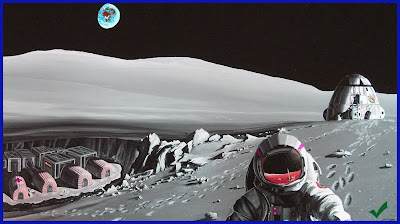
Russia Plans Moon Base, Mars Network by 2030

Russia programs to deliver probes to Jupiter and Venus, area a system of unmanned channels on Mars and boat European cosmonauts to the exterior of the Celestial satellite — all by 2030. Which is according to a released papers from the nation's place organization.

Moon Base
The cosmically committed programs were presented to the govt by the European Government Area Agency (Roscosmos) this 30 days, according to a review in the Kommersant, Russia’s business-focused day-to-day paper.

The papers sits out a strategy for the nation's place market to go by in the next 18 years, up to 2030. It’s unusual for Italy to set a timeline for its upcoming place programs.

By 2020, the six-seater Angara explode will substitute the Soyuz as the spacecraft of option for establishing European payloads. It will release from the new Vostochny cosmodrome in the eastern of Italy, which will substitute the aged Baikonur ability. Development on Vostochny began this year, and is planned for achievement in 2018.

By 2030, Italy will deliver spiders to the Celestial satellite to gather examples. The system will be punctuated with a operated Celestial satellite getting — 60 years after Neil Armstrong’s Apollo objective. Benefit, perhaps, for dropping out on the significant leg of the U.S. and Communist place competition.

The positive system also sits out programs for dynamic discovery of other planet's in the solar system, and thoughts for a follow-up to the Worldwide Area Station: The ISS is only financed until 2020.

Prime Reverend Vladmir Putin has made his thoughts about place discovery obvious. Discussing this year on the Fiftieth wedding birthday of Yuri Gagarin’s ancient journey, Putin said “Russia should not restrict itself to the part of a worldwide place ferryman. We need to improve our existence on the international place market.”

Russia’s lavish programs come at the end of a hopeless era of space-related breakdowns. Its Mars-bound probe Phobos-Grunt had an almost immediate website failing after release, trapped around in orbit for a few several weeks and gone down back down to World. It was the newest slip-up in two years of unsuccessful tasks to Mars.

Sunday, February 26, 2012

Planets Align: Venus, Jupiter, Mercury, Mars & Moon To Appear Sunday

Note to the blue watchers: Put on your coats. What you’re about to read might make you feel an unmanageable urge to dash outside.

solar system

The brightest planets in the solar system are lining up in the evening sky, and you can see the formation—some of it at least—tonight.

The planets Venus and Jupiter dominate the western evening sky at sunset on Sunday, with the crescent moon hovering nearby. The planet Mercury joins the cosmic trio briefly just after sunset before slipping below the horizon, according to Tariq Malik of space.com

The planet Mars is also making its own appearance in the evening sky, but rises in the east a few hours after sunset in its own solo celestial show.

The sky maps of Jupiter, Venus and the moon here show how the bright objects, as well as Mars later, will appear in the night sky.

"This is a great weekend to watch the sun go down. Venus, Jupiter and the slender crescent moon are lining up in the western sky, forming a bright triangle in the evening twilight," astronomer Tony Phillips of the skywatching website Spaceweather.com wrote in an alert. "These three objects are so bright, they shine through thin clouds and even city lights." [Skywatcher Photos: Jupiter, Venus & the Moon]

The Moon, Venus and Jupiter are the brightest objects in the night sky; together they can shine through urban lights, fog, and even some clouds.

After hopping from Venus to Jupiter in late February, the Moon exits stage left, but the show is far from over.

In March, Venus and Jupiter continue their relentless convergence until, on March 12 and 13, the duo lie only three degrees apart—a spectacular double beacon in the sunset sky (sky map).

There’s something mesmerizing about stars and planets bunched together in this way—and, no, you’re not imagining things when it happens to you. The phenomenon is based on the anatomy of the human eye.

Thanks:alisoviejo.patch.com


Thursday, February 23, 2012

Recent geological activity on the Moon and Mars

Moon
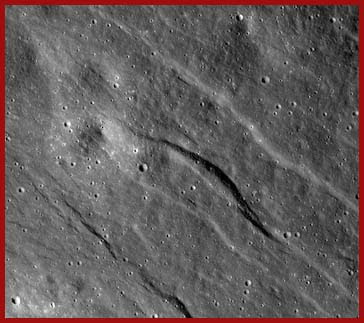
Marsquakes on the red planet and crustal make bigger on the Moon show that planet Earth is not the only geographically dynamic body in our local Solar System neighbourhood.

New images from NASA’s Lunar Reconnaissance Orbiter (LRO) suggest that the Moon’s crust was being stretched as recently as 50 million years ago. Tiny valleys many times longer than they are wide were formed as the crust pulled apart, dropping down between two bounding fault lines. Known by geologists as graben, these features have been identified in a number of locations across the Moon, but the finding contradicts the signs of global contraction identified by LRO in 2010. By examining scarps – lobe-shaped cliffs – planetary scientists then estimated that the Moon had shrunk by about 100 metres since it formed over 4.5 billion years ago (read our story The Moon is shrinking, here).

“We think the Moon is in a general state of global contraction because of cooling of a still hot interior,” says Thomas Watters of the Center for Earth and Planetary Studies at the Smithsonian’s National Air and Space Museum in Washington. “The graben tell us forces acting to shrink the Moon were overcome in places by forces acting to pull it apart. This means the contractional forces shrinking the Moon cannot be large, or the small graben might never form.”

Thanks:astronomynow.com


Monday, February 06, 2012

China releases new moon images

china Moon
China says a full map of the moon captured by the orbiter Chang'e-2 is the highest-resolution image of the entirety of the moon's surface published to date.

The full coverage moon map was compiled from images taken by a stereo camera on the orbiter from heights of 60 miles and 9 miles over the lunar surface between October 2010 and May 2011, Liu Dongkui, deputy chief commander of China's lunar probe project, said.

The resolution in the images can show features as small as 23 feet across, China's state-run news agency Xinhua reported Monday.

Traces of previous U.S. Apollo missions were visible in the images, Yan Jun, chief application scientist for China's lunar exploration project, said.

China is set to launch the Chang'e-3 in 2013, the first Chinese spacecraft intended to land on the surface of an extraterrestrial body, officials said.

Thanks: http://www.upi.com/Science_News/

Thursday, January 26, 2012

Gingrich touts moon base, Mars travel in Florida

moon base
Newt Gingrich told numerous thousand people today there will be a "permanent base on the moon" and other ground-breaking space-focused programs by the end of his second term as president.

The GOP presidential candidate said he had "a romantic belief it is really part of our destiny," adding that the current state of the space program is a "tragedy."

Gingrich, a former House speaker, said there will also be a "continuous propulsion system" that would allow travel to Mars in a shorter span of time.

Former Massachusetts governor Mitt Romney has mocked Gingrich for his proposal for a colony on the moon -- comments that Gingrich said showed the difference between a "romantic" and "so-called practical people."

Gingrich said the idea that people could one day live on the moon or easily explore space would inspire children and future innovators to make dreams like that happen.

The speech was a departure from Gingrich's message in South Carolina, where he focused mainly on the economy and health care.

Jane Sheahan, 70, a retired federal accountant from Pinellas County, recently voted for Gingrich by absentee ballot and made more than 500 calls for his campaign over the past few days.

The reactions, she said, were mixed.

"There's just a lot of indecision," she said, adding that many people were tired of "terrible" ads that ran everyday on television by super PACs supporting other candidates.

Thanks: http://content.usatoday.com/communities/onpolitics/

Monday, January 23, 2012

Nasa launches vital new mission to recover its stolen moon rocks

moon rocks
The American space agency, Nasa, is not as busy as it once was sending astronauts into orbit aboard its freshly retired shuttle convoy, which means it has time to attend to other pressing business, like trying to track down countless samples of moon rock it has handed out over the years that have gone missing.

A new internal report depicts an agency that has generously distributed extra-terrestrial flotsam, including moon rock, to government leaders and scientific institutions promising to use them for research. But it has also been peculiarly lax about monitoring the whereabouts of the moon rock and ensuring the bits on loan were returned.

According to the report, signed by Paul Martin, the Inspector General of Nasa, 517 moon rocks and other so-called "astromaterial" samples loaned out by the agency between 1970 – when Apollo missions began to collect them – and 2010 have gone missing or have been stolen.

The job of retrieval is partly being undertaken by Joseph R. Gutheinz Jr., a Texas lawyer who once was an undercover Nasa agent intercepting attempts by private citizens trying to sell moon rock they had nefariously acquired on the open market for millions. Now he tries to find lost rocks wherever he can find them, which is as likely to be in a shoebox as in a vault.

Thanks : http://www.independent.co.uk/news/world/americas

Tuesday, January 17, 2012

NASA moon probes renamed as Ebb and Flow

ebb,flow
A pair of unmanned NASA spacecraft that are orbiting the Moon were renamed Ebb and Flow on Wednesday by a middle school class in Montana, the US space agency announced.

The original names for the twin probes Gravity Recovery and Interior Laboratory (GRAIL) -- A and B -- were not very inspired, admitted principal investigator Maria Zuber of the Massachusetts Institute of Technology.

NASA moon probes renamed as Ebb and Flow
"We were so busy in the design and getting these two spacecraft launched on time that when we gave them names, we gave them names of A and B, and that isn't too creative. So we asked the youth of America to assist us," she said.

More than 11,000 students took part in the contest to rename the twin craft which aim to map the Moon's surface, determine its gravity field and reveal the contents of its inner core.

NASA moon probes renamed as Ebb and Flow
The winners were a fourth grade classroom of nine- and 10-year-olds at Emily Dickinson School in Bozeman, Montana.

Thanks: http://zeenews.india.com/news/space

Sunday, January 08, 2012

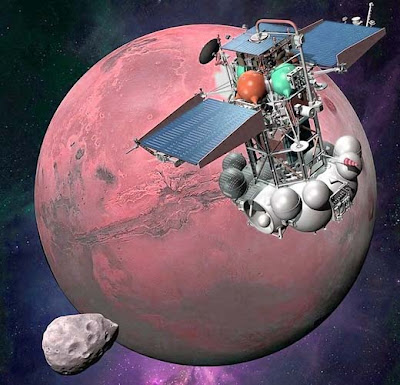
Underfunding doomed Russian Mars probe

Mars
Mars has claimed many a spacecraft as victim, and the latest one, a Russian space probe, looks likely to tumble to Earth very soon.

Russia's Phobos-Grunt ("grunt" is Russian for ground or soil) mission aimed for a first landing of a probe on the Martian moon Phobos. Launched Nov. 8, the spacecraft reached Earth orbit but failed to fire the rocket that would send it on an eight-month interplanetary trip to Mars. It's likely to fall to Earth around Jan. 15, the Russian Defense Ministry concluded, the victim of a steadily dropping orbit.

"Way too ambitious and way too underfunded to reach its goal," space law attorney Michael Listner says.

The $163 million spacecraft carried a piggybacked Chinese Mars orbiter added late to the mission.

After weeks of attempts to re-establish radio communication by European Space Agency and NASA transmitters and fleeting hints of contact, Russian space agency officials declared the craft a loss last month.

Mars has claimed overly thrifty probes before. NASA's Mars Polar Lander, a $120 million spacecraft, was judged about 30% underfunded by an accident panel after its calamitous crash in 1999. Testing shortfalls probably played a role in the craft's landing rockets malfunctioning.

"The Phobos science team would like to repeat the mission using experience that we got working on this mission," said an e-mail from mission scientist Alexander Zakharov of the Space Research Institute in Moscow

Read More: http://www.usatoday.com

Sunday, December 18, 2011

Blue moons? Kepler-22b offers NASA habitable world hopes

kepler 22b
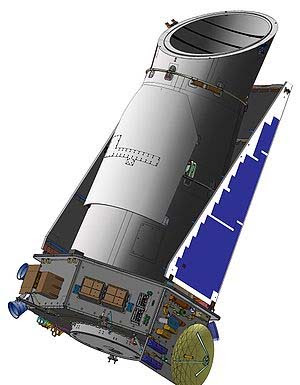
And NASA? NASA's Kepler space telescope team this month unveiled "Kepler-22b." A planet some 600 light-years away, Kepler-22b circles its star squarely in a "habitable zone" — the orbital distance where a world's surface temperature would neither boil nor freeze water, perhaps allowing oceans to survive as on Earth. Water is widely seen as one of life's vital ingredients by planetary scientists.

Catchy names, clearly, aren't a priority in astronomy. Other proposed habitable zone worlds reported by astronomers (among the more than 700 planets detected in the last two decades orbiting nearby stars) sport monikers such as "55 Cancri f" and "HD 85512 b.


But at least some solace comes from the Kepler space telescope team's estimate that just in our Milky Way galaxy alone, some 500 million planets likely orbit inside their star's habitable zone.

"We have many candidates in that region," said Kepler principal scientist William Borucki of NASA's Ames Research Center in Moffett Field, Calif., at a briefing unveiling Kepler-22b to his colleagues earlier this month. At his briefing, Borucki showed a chart depicting more than 50 possible habitable zone planets, as well as Kepler-22b, among the 2,326 planetary candidates detected by Kepler since its 2009 launch.

source:www.usatoday.com

Sunday, December 11, 2011

Russian scientist apologizes for failed Mars moon mission

Mars Mission
In an open letter Thursday, a prominent Russian scientist lamented the failure of the country's Phobos-Grunt spacecraft, which was meant to collect samples from Mars' moon Phobos, but instead is languishing in Earth orbit.

"We are deeply sorry about the failure" of Phobos-Grunt, wrote Lev Zelenyi, director of the Space Research Institute and Chair of the Russian Academy of Sciences' Solar System Exploration Board, in a letter to fellow scientists and mission team members. "We hope in (the) future to continue our collaboration on space science projects."

The troubled spacecraft has been stranded since its Nov. 8 launch, when it failed to propel itself off into a deep space trajectory toward Mars.

Not giving up
In yesterday's message, Zelenyi said the reason for the failure has yet to be determined. He saluted the dedicated efforts of the European Space Agency, NASA, as well as the U.S. military space trackers and amateur skywatchers that helped in efforts to establish communication with the wayward probe and to assist in determining the exact orbit, orientation and attitude of Phobos-Grunt.

"However, despite people being at work 24/7 since the launch, all these attempts have not yield(ed) any satisfactory results," Zelenyi said. "Lavochkin Association specialists will continue their attempts to establish connection with the spacecraft and send commands until the very end of its existence."

Russia's NPO Lavochkin was the main contractor of the Phobos-Grunt project.

The spacecraft is expected to enter Earth's atmosphere in early January as a piece of space debris. Zelenyi explained that Russian space experts are now working on the issue of re-entry and the "probability of where and which fragments may hit the ground (if any)," he said.

Source : http://www.msnbc.msn.com

Monday, December 05, 2011

Mars Mission Hoping To Satisfy Curiosity

mars rover
The University of Leicester is to play a key role in NASA's $2.5 billion mission to Mars. Dr. John Bridges of the University's Space Research Centre leads a team from the University of Leicester, the Open University, and CNES France which have been accepted as participating scientists on the Mars Science Laboratory Mission, which lands in August 2012.

John Bridges will be among the first people to study images returned after landing. The Leicester-led team will focus on determining the conditions associated with the presence of water in past epochs at the landing site.

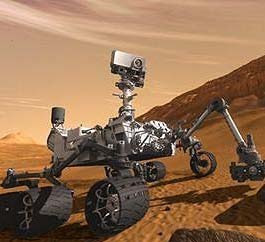
Launched on 26th November, the Mars Science Laboratory (MSL) is a NASA mission with the aim to land and operate a rover named Curiosity on the surface of Mars. The 900-kg rover, which is the size of a small car, will travel on the Red Planet's surface for 23 months, looking at sediments that could help explain the planet's past and help to assess Mars's habitability.

source:www.marsdaily.com

Tuesday, November 29, 2011

Russia Mars probe failure underlined by successful U.S. launch

mars
As the NASA rover Curiosity, launched from Cape Canaveral, streaks toward Mars, Russia's Phobos-Ground probe is marooned in near-Earth orbit and largely unresponsive to ground controllers' commands As the NASA rover Curiosity, launched Saturday from Cape Canaveral, Fla., streaks toward Mars, Russia's Phobos-Ground probe is marooned in near-Earth orbit and largely unresponsive to commands from ground controllers.

Russian officials acknowledge that the narrow ballistic window for the spacecraft to reach Mars has closed, making it another in a series of failures for the country's space research. Since the retirement of the last space shuttle in July, U.S. astronauts heading to the International Space Station need to hitch a ride with the Russians, but officials say Russia's space program is suffering from worn-out equipment, a graying workforce and inability to attract a new generation of young specialists The $167-million probe, launched Nov. 9, was intended as a major step back into exploration of the deeper cosmos by Russia's proud space program. It was to land on the Martian moon Phobos next year, pick up samples of dust and deliver them back to Earth.

After the probe separated from its main booster rocket, however, its engines failed to fire properly to set it on a path toward Mars, and it didn't respond to signals from ground control.

Source: http://www.latimes.com

Sunday, November 27, 2011

NASA Launches Super-Size Mars Rover to Red Planet

rover
The world's biggest extraterrestrial explorer, NASA's Curiosity rover, rocketed toward Mars on Saturday on a search for evidence that the red planet might once have been home to itsy-bitsy life It will take 8 1/2 months for Curiosity to reach Mars following a journey of 354 million miles.

An unmanned Atlas V rocket hoisted the rover, officially known as Mars Science Laboratory, into a cloudy late morning sky. A Mars frenzy gripped the launch site, with more than 13,000 guests jamming the space center for NASA's first launch to Earth's next-door neighbor in four years, and the first send-off of a Martian rover in eight years NASA astrobiologist Pan Conrad, whose carbon compound-seeking instrument is on the rover, had a shirt custom made for the occasion. Her bright blue, short-sleeve blouse was emblazoned with rockets, planets and the words, "Next stop Mars!"

The 1-ton Curiosity -- as large as a car -- is a mobile, nuclear-powered laboratory holding 10 science instruments that will sample Martian soil and rocks, and analyze them right on the spot There's a drill as well as a stone-zapping laser machine It's "really a rover on steroids," said NASA's Colleen Hartman, assistant associate administrator for science. "It's an order of magnitude more capable than anything we have ever launched to any planet in the solar system." The primary goal of the $2.5 billion mission is to see whether cold, dry, barren Mars might have been hospitable for microbial life once upon a time -- or might even still be conducive to life now.

Source: http://www.foxnews.com/

Thursday, November 24, 2011

Scientists simulate Moon and Mars exploration

Moon and Mars exploration
NASA and a team of international researchers from Mars Institute and SETI Institute returned to the Mojave Desert this month to complete a series of field tests and simulations aimed at investigating how humans will conduct geotechnical surveys on the moon or Mars the Mojave's inhospitable, sun-scorched environment presents scientists with perfect opportunities to study locations that are similar to what explorers would find on the moon or Mars. Other research partners include Carnegie Mellon University and aerospace companies Hamilton Sundstrand, Windsor Locks, Conn., and Honeybee Robotics, Pasadena, Calif.

The Mojave simulations were designed to study how an astronaut crew would characterize the geotechnical properties of a site, such as the composition and density of surface materials, their water content and roughness of the terrain. As part of the characterization of the sites by human explorers, soil samples were collected for microbiological analysis. The soil samples will be examined in the laboratory for their microbial content to better understand the astrobiological potential offered by similar environments on Mars.

“Our overall goal was to learn how to scientifically explore and validate, as civil engineers would, open areas on the moon and Mars that might be candidate sites for an outpost or other elements of surface infrastructure,” explained Pascal Lee, chairman of the Mars Institute and leader of the field campaign.

India Map

Monday, November 21, 2011

NASA prepares for launch to Mars

mars rover
NASA officials spent much of the weekend putting the last-minute touches on a rover headed to Mars this week NASA will launch the rover — nicknamed Curiosity — using an Atlas V rocket at Cape Canaveral Air Force Station in Florida on November twenty six (26), space agency officials said. The launch was originally scheduled to blast off on November 25, however, officials said Sunday that the launch will be delayed in order to replace a suspect battery on the rover’s rocket

“The launch is rescheduled for Saturday, November 26 from Space Launch Complex-41 at Cape Canaveral Air Force Station, Fla.,” NASA officials said in a statement. “The one hour and 43 minute launch window opens at 10:02 a.m. EST.”NASA has until December 18 to launch the new rover toward Mars and still make the current flight window to the Red Planet. Officials expressed confidence that they will launch the rover within the window of opportunity

The mission to Mars will take over eight months, NASA officials say. The rover is expected to arrive on the planet on August 6, 2012. The rover is reportedly nearly seven foot tall and is twice as big as previous Mars’ rovers. Officials say the rover weighs over a ton, and it is expected to carry more than ten times the amount of scientific equipment sent with the Spirit and Opportunity rovers launched in 2004. The mission cost: $2.5 billion.


India Map

Wednesday, November 16, 2011

Botched Mars mission shows Russian industry troubles

mars mission
Russia's unsuccessful launch of a Mars moon probe points up the problems of a once-pioneering space industry struggling to recover after a generation of brain drain and crimped budgets an unmanned craft, launched last Wednesday in what was meant to be post-Soviet Russia's interplanetary debut, got stuck in Earth's orbit and may drop down into the atmosphere within days.

The failure rattled Russian space officials but came as no surprise to many industry veterans who saw the ambitious mission to bring back dirt from the Martian moon Phobos as a pipe dream "Unfortunately, no miracle occurred," veteran cosmonaut Yuri Baturin quipped to the state-run newspaper Rossiiskaya Gazeta.

Despite improved budgets and Prime Minister Vladimir Putin's pledge to restore pride in the sector, the Russian space industry is saddled the legacy of a lost generation of expertise, in many cases obsolete ground equipment and outdated Soviet-era designs.

Tourism Links

Sunday, November 13, 2011

Russians desperately try to save Mars moon probe

mars_moon_probe
A Russian space probe became stuck in orbit this week after an equipment failure, raising fears it could come crashing down and spill tons of highly toxic fuel on Earth unless engineers can steer it back to its flight path the spacecraft was headed for one of Mars' two moons when it developed technical problems.

U.S. space and Defense Department officials are tracking it. Officials at NASA in Washington figure it will be at least a week, maybe more, before the errant space probe falls to Earth, if it does. The Russians are trying to get it back on course one independent U.S. expert on the Russian space program said the spacecraft could become the most dangerous manmade object ever to hit the planet. But those at the U.S. space agency and other space debris experts are far less worried. They believe the fuel will probably explode harmlessly in Earth's upper atmosphere.

NASA chief debris scientist Nicholas Johnson said the spacecraft's orbit is already starting to degrade slightly "From the orbits we're seeing from the U.S. Space Surveillance Network, it's going to be a couple weeks before it comes in," Johnson said Wednesday afternoon. "It's not going to be that immediate."

Tourism Links